Give It Your Best! Workplace Posters in the United States
This exhibit will feature more than seventy posters from the collections of the Hagley Museum and Library. The posters were printed to improve morale and bolster productivity and are also colorful and striking examples of graphic art. The exhibit spans from 1917 through World War II. Displayed posters will include Joseph Pennell’s World War I poster “That Liberty Shall Not Perish,” the Seagram Corporation’s “Loose Lips Might Sink Ships,” and Norman Rockwell’s “Four Freedoms.” On Saturdays at 2, 3, and 4 p.m., volunteers will give a fifteen-minute exhibit tour. Exhibit only admission is $5 for adults, $2 for children six through fourteen, and free for children five and under. Exhibit included in regular admission. Free for members. Use Hagley’s main entrance off Route 141 in Wilmington, Delaware.
Ladies’ Hand Fans: Designed for Utility, Grace, and Style
This new exhibit is housed in the du Pont family ancestral home, Eleutherian Mills. View nineteen ladies’ fans that span the nineteenth and early-twentieth centuries from the du Pont family collection. The exhibit is included in regular admission and tour.
Ladies’ hand fans were first created for cooling purposes, and later evolved to become an integral part of a lady’s costume. On display will be striking pieces like a hand-painted Tiffany fan with mother-of-pearl sticks and lace embellishments and another made of carved ivory and duck feathers. Some fans have stories to tell like the tourist fan that serves as a travel log or the “scrap” fan (made in the technique of scrap-booking) that illustrates some local history. Variations of design, materials, embellishments, and style make these fans both intriguing and beautiful.
DuPont Science and Discovery
With this exhibit, Hagley Museum offers visitors a look at 200 years of DuPont Company history. The company's inception and early days are currently presented and preserved outdoors on Hagley's 235 acres along the Brandywine River. This new dynamic, interactive, state-of-the-art exhibit takes visitors through the company's transition from a nineteenth-century manufacturer of explosives to the research-based firm that has helped transform everyday life in the twentieth century. In the exhibit, youngsters will be inspired and others will marvel at the company's innovative products while sitting in Jeff Gordon's #24 NASCAR racer, experiencing an astronaut's space suit, "meeting" some scientists, and so much more. Several hands-on components explore the materials science concepts behind many of the company's revolutionary products, from the Nomex® coats that protect firemen to nylon stockings. The exhibit was made possible by a grant from DuPont.
DuPont: The Explosives Era
This exhibit is the perfect prelude to a tour through the nineteenth-century industrial community at Hagley that once surrounded the manufacture of DuPont's original product, gunpowder. It details the du Pont family's decision to come to America, the choice of a site for the black powder manufactory, the early years of the company, and a concentrated exploration of the role of explosives in nineteenth- and early-twentieth-century life. The exhibit was made possible by a grant from DuPont.
Eleutherian Mills
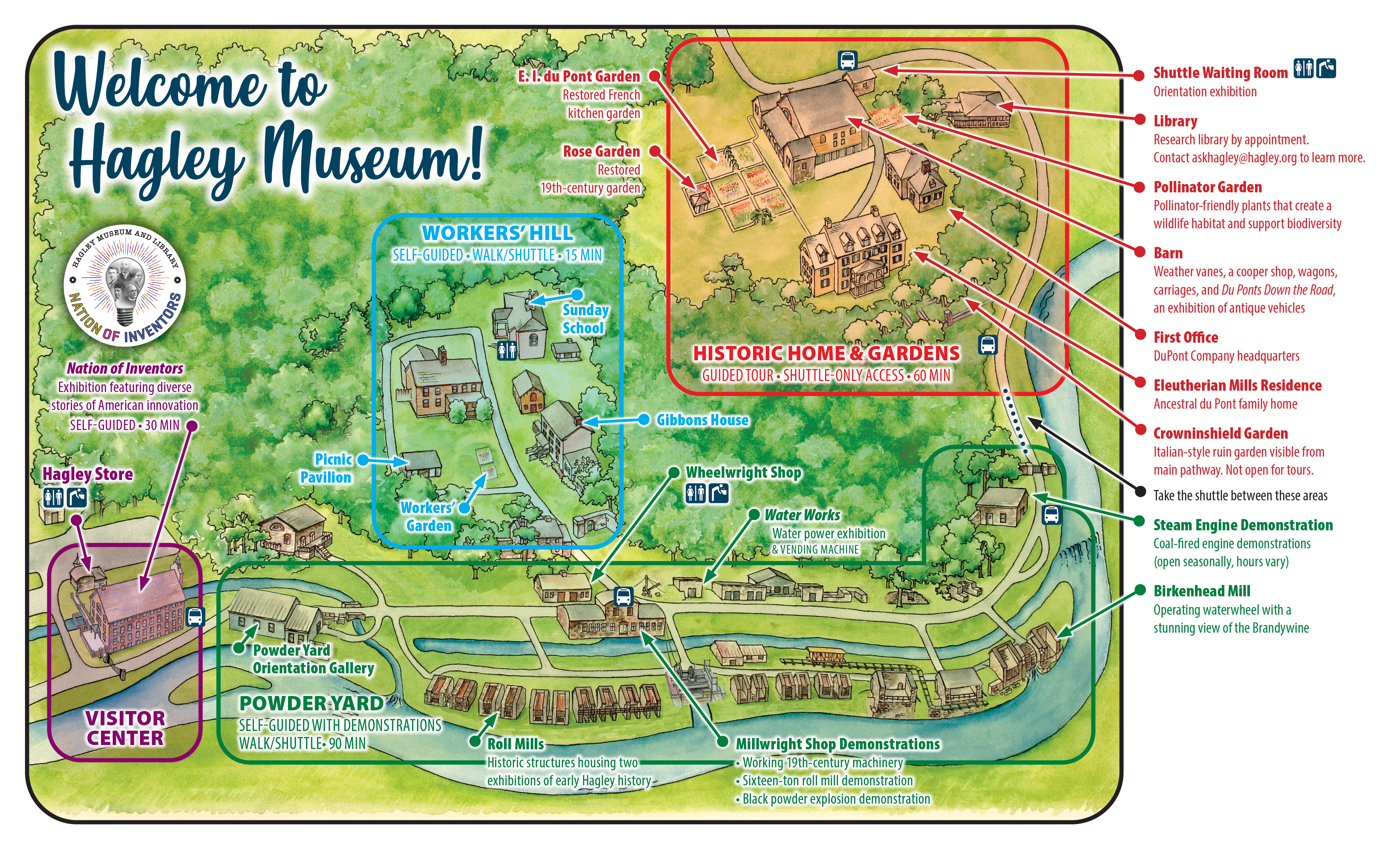
The first du Pont Family home in America, Eleutherian Mills, was built by E. I. du Pont in 1803. Situated on the crest of a hill, it affords a commanding view of the Brandywine River, with a dam which fed water to the original millrace. This charming Georgian-style residence is furnished with antiques and memorabilia of the five generations of du Ponts associated with the home. Adjoining it is the restored French-style garden created by E. I. du Pont, an avid botanist.
Near the residence are two other exhibits, the First Office and the Barn.
The First Office of the Du Pont Company was constructed in 1837 and remained the nerve center for the company for more than fifty years. An early typewriter, ledgers, and telegraph key reflect the business activities that were once housed in this building.
The Barn features a collection of nineteenth century domestic, farm, and powder yard vehicles, a collection of weather vanes, agricultural tools and implements, as well as a Conestoga wagon. On the lower level of the Barn an antique automobile exhibit highlights the du Pont Motors car manufactory, featuring a 1928 Du Pont Motors Phaeton and contrasting it to a 1911 Detroit Electric car that also belonged to a family member.
Easy Does It! How Machines Make Life Easier
This colorful, interactive exhibit features plenty of hands-on fun, making a perfect educational adventure for all. Explore the funtastic fundamentals of simple machine technology including wheels and axles, levers, gears, and pulleys. While visiting the exhibit, a single youngster can raise family and friends to new heights on the Lift It platform with the help of two pulleys. Visitors of all ages can get geared up for learning while trying a rack and pinion steering mechanism, a bicycle, and more. Then there are examples of simple machines from work and home including the wonders of the wheelbarrow, the whirring of an eggbeater, and the power of a line shaft.
This exhibit is currently open weekends only.
Hagley Powder Yard
In the Powder Yard, massive stone mills, storehouses, and a waterwheel recall the time when waterpower was the source of energy. Millstreams at Hagley still channel water to operate machinery. Exhibits and working models tell the history of the economic and technological expansion of the Brandywine region and the nation. Powdermen and machinists demonstrate a water turbine, a steam engine, a powder tester, and a working machine shop.
Workers' Hill
Workers' Hill focuses on the social and family history of the workers who operated the powder mills. Costumed interpreters reflect life during the late nineteenth century in the Gibbons House, home to powder yard foremen and their families. In the Brandywine Manufacturers' Sunday School, constructed in 1817, children of mill workers learned to read, write, and cipher before Delaware provided public education. |