
I don’t know about you, dear reader, but I am ready for fall. After one of the hottest summers on record, I am looking forward to falling temperatures and falling leaves. I also look forward to the start of college football season when I get to watch my University of Delaware Fightin Blue Hens take on the Vanderbilt University Commodores on September 12th.
That reminds me of a scientist, inventor, and professor at Vanderbilt whose trailblazing experiments in his twenties opened enormous possibilities for a largely underappreciated metal that is widely used today. However, he is probably known more to folks as the "father of Southern football". Here is the story of William Lofland Dudley!

Born in Covington, Kentucky, young Dudley was fascinated by science, publishing in Scientific American at age 15. He studied at the University of Cincinnati and graduated with a degree in chemistry in 1880.
That year, an inventor and pen manufacturer named John Holland (1838-1924) came to him with a problem. Holland patented a process for casting a metal you may have heard about in chemistry class called iridium. Iridium has unique properties that had enormous potential, especially its extreme hardness and resistance to temperature and corrosion. But, due to its powdered state and extremely high melting point, scientists struggled to process it for centuries.
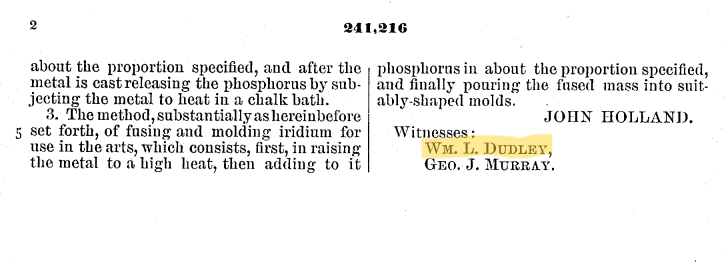
Holland discovered that he could create a castable molten metal by adding phosphorus to iridium powder in a sand crucible under extremely high heat. But the resulting samples were impregnated with the phosphorus. Holland asked Dudley to help him find a way to remove it. By repeatedly applying lime under great heat, Dudley burned off the phosphorus "leaving the metal [as] pure, hard, and non-fusible as in its natural state". Holland could now "mold the metal into ingots of any shape and size" allowing iridium to be produced on an industrial scale. Holland was awarded patent #241,216 for this process on May 10, 1881. While Dudley was not assigned any rights in the patent, he did serve as a witness.
What was iridium used for? Its strength and resistance to wear and corrosion made it the perfect metal for the nibs on Holland’s fountain pens. Today, it has applications across many industries such as aircraft and rocket parts, electronics and semiconductor production, as well as spinnerets for weaving polymers like DuPont nylon and rayon. Its resistance to temperature, corrosion, and pressure make it an ideal choice for metal alloys used in wet, pressurized environments such as deep beneath the sea and in the production of corrosive chemicals. Its heat resistance is essential to its use in crucibles and the tips of engine spark plugs. Its presence in meteorites is also useful in the study of dinosaurs!
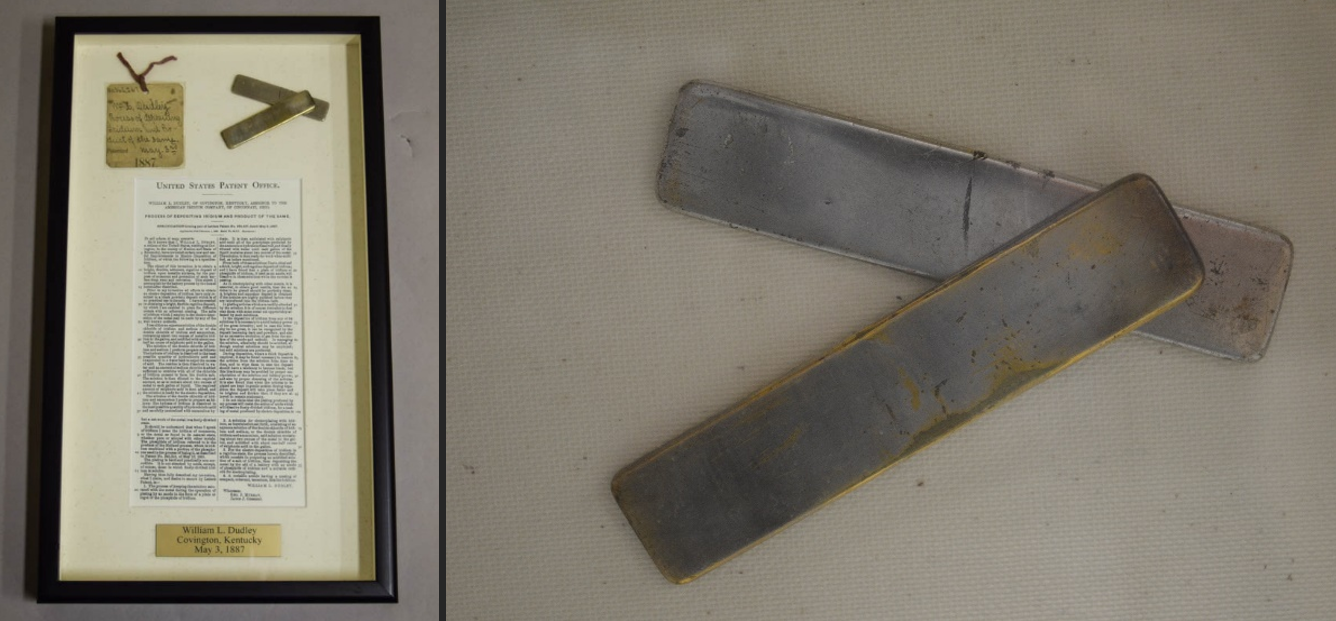
Not long after Dudley assisted Holland, he patented his own process for using electrolysis to apply a layer of iridium to other metals "for the purpose of ornament and protection of such surfaces from wear and corrosion". He took a chunk of iridium, "the product of the Holland process", and connected it to a battery and another hunk of metal to be plated with iridium. He placed this apparatus in an electrolytic solution consisting of iridium chloride, sodium or ammonium, and sulfuric acid diluted by water. The electric current deposited a coating that was bright, consistent, and flexible. He assigned this patent to the American Iridium Company which he and Holland founded to explore potential consumer applications. Hagley owns the samples that he submitted with his patent application, and they are framed within this shadowbox.
Dudley’s work with iridium was just one of his many noteworthy accomplishments. He served as professor of chemistry and toxicology at Miami Medical College, now a part of the University of Cincinnati. At the young age of 27, he accepted the position of professor and chair of the chemistry department at Vanderbilt University and became dean of their school of medicine at age 36. Nearly a legend at the school, he raised admission standards, increased enrollment, recruited top talent for the faculty, and added new buildings to the campus.
He studied tobacco smoke and determined that carbon monoxide caused its toxicity. He was one of the first to publish on the physiological effects of X-rays on patients. A proponent of American technology and innovation, he served as commissioner of the Cincinnati Industrial Exposition and as director of affairs for the Tennessee Centennial Exposition. Sadly, he died at the young age of 55 while travelling on a train home to Nashville.
By now, I’m sure you are wondering what does all this have to do with football? Well, I’d wager Bill Dudley loved football nearly as much as he loved science.
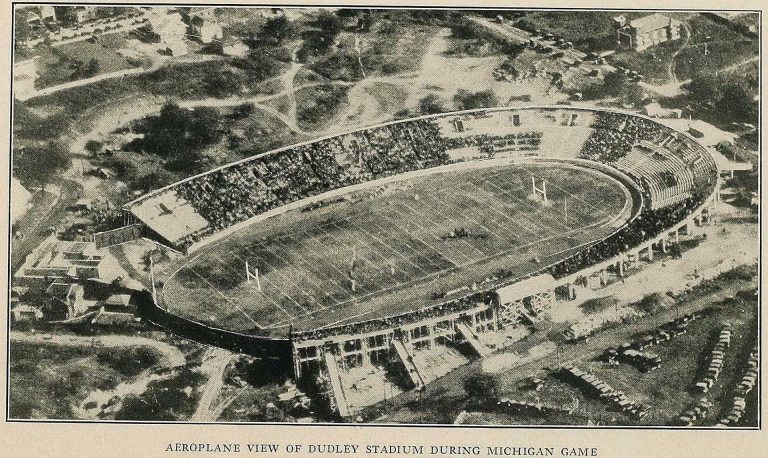
He was a leading figure in the establishment of the first southern athletic conference called the Southeastern Intercollegiate Athletic Association (SIAA). This included many of the elite Division I football schools in the current Southeastern Conference (SEC) and the Atlantic Coast Conference (ACC). He helped establish rules governing the sport through the National Collegiate Athletic Association (NCAA). This earned him the moniker "father of southern football" and, through his own advocacy of the sport, the "father of Vanderbilt football". When Vanderbilt built the first stadium exclusively for football in the south, they named it "Dudley Field".
I hope that you, like me, will take a moment to remember Bill Dudley’s contribution to American technology and American football during a game this year. But if Vandy is beating my Blue Hens, I apologize in advance for whatever unkind thoughts or words I might have towards Dudley and his Commodores.
Photograph sources:
Dudley Memorial Stadium, c. 1923
William Lofland Dudley (1859-1914)
Chris Cascio is the Alan W. Rothschild Assistant Curator, Patent Models at Hagley Museum and Library.