
Patents and patent models represent one person's unique solution to an everyday problem. When we think of nineteenth-century inventions, we tend to picture things like the locomotive, the steam engine, or the telephone. But these represent only a tiny fraction of the innovations that emerged during the Golden Age of Inventing. Nineteenth-century Americans used inventing to improve every aspect of their lives, turning to machines and industrial processes the way modern Americans turn to the internet, apps, or AI to make life easier, cheaper, or safer.
As Halloween approaches, let's turn to a more seasonal example to illustrate this point: death and dying. What was once a private matter, handled within the home by immediate family, became an entire industry in nineteenth-century America. A whole class of professionals—including funeral directors and embalmers—began handling remains and orchestrating mourning ceremonies for friends and family outside the home.
That process served the needs of the living. Mourning the loss of a loved one and preparing for life without them mattered just as much then as it does now. But underlying this industry was a very practical and pragmatic need: how to safely dispose of something that could endanger public health.
As industrialization drove people into cities, urban areas became a sanitation nightmare. Human and animal waste, animal carcasses, garbage, and industrial byproducts were disposed of improperly, since the necessary infrastructure and policies didn't yet exist. This problem extended to the bodies of the dead.
Before the population boom of the Industrial Revolution, people were buried in churchyards or private family plots, often without much consideration for the site. Runoff from these burials sometimes fouled wells and other public water sources, spreading sickness and disease—a problem that only worsened as populations grew more concentrated. Public health advocates pushed for more thoughtful planning and stricter burial regulations.
Not surprisingly, inventors sensed an opportunity and patented innovative solutions. Techniques such as embalming, sealed metal caskets, and pre-manufactured concrete burial vaults were designed to keep the byproducts of decomposition from escaping into the surrounding soil and water supply.
Cremation represented another potential solution. The practice of burning the deceased has existed for centuries across different civilizations and cultures, typically reducing the body to ash on an open-air pyre. Ever eager to industrialize every process, inventors developed modern crematories—enclosed, high-temperature ovens—as an alternative by the end of the nineteenth century. The earthly remains of one inventor represented in Hagley's patent model collection belonged to the first person cremated this way in America.
His full name wouldn't fit on a modern driver's license: Joseph Henry Louis Charles de Palm. For brevity, let's call him Baron de Palm.
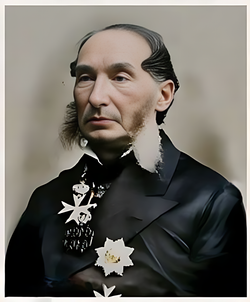
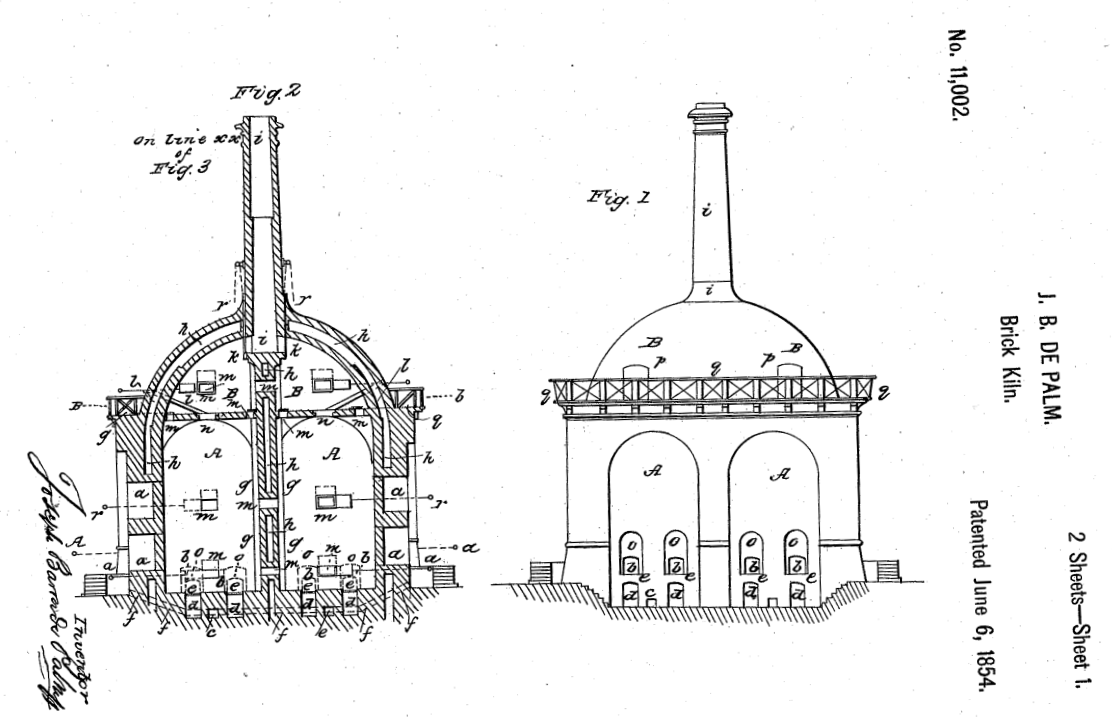
A member of an ancient Bavarian baronial family, de Palm patented a kiln for baking all types of ceramics at once. By dividing the kiln into separate compartments and adding registers, flues, and dampers to vary the temperature, he claimed it could fire "solid, coarse, good and lighter and more delicate ware"—everything from bricks to sewer pipes to pottery—simultaneously, saving both labor and fuel. It also reduced spoilage, and thanks to a unique chimney that "consume[d] its own smoke," it was well suited to "large, populated cities and towns." Below is the patent drawing and a photograph of his model, though sadly the dome and chimney are missing.
Baron de Palm was quite a character. According to Appleton's Encyclopedia of American Biography, he worked in the German diplomatic service and at one point served as chamberlain to the King of Bavaria. He arrived in the U.S. sometime before his 1854 patent and, like other curious Europeans of the era, spent time among Native tribes in the Pacific Northwest.
He developed an interest in mysticism and befriended Helena "Madame" Blavatsky and Colonel Henry Steel Olcott, founding members of the Theosophical Society, which advocated for "the scientific investigation of psychic or so-called 'spiritualistic' phenomena" and studied ancient religions to explore "the latent divine powers of man." De Palm joined the society, but his health soon deteriorated. Alone in a foreign country with no one to care for him, he accepted Olcott's invitation to stay with him. Olcott summoned doctors to treat his symptoms and, as his condition worsened, helped him draft a will. In it, the Baron left property to a lady friend in Chicago, with the rest of his estate going to Olcott "in gratitude for his kindness to me." He died soon after, on May 20, 1876. Following his death, Olcott said he preserved the body by "packing the cadaver in desiccated clay impregnated with the carbolic and other vapors of distilled coal tar."
According to Olcott's diary, he and the Baron had discussed what should be done with his remains before he died. The Baron feared being buried alive, and the two men discussed the successful cremation of Lady Katherine Dilke in Dresden, Germany, in December 1874. The Baron decided he, too, wanted to be cremated. Lady Dilke had been cremated in a closed, gas-burning oven built specifically for the purpose by German engineer Friedrich Siemens. Was there such a facility in America?
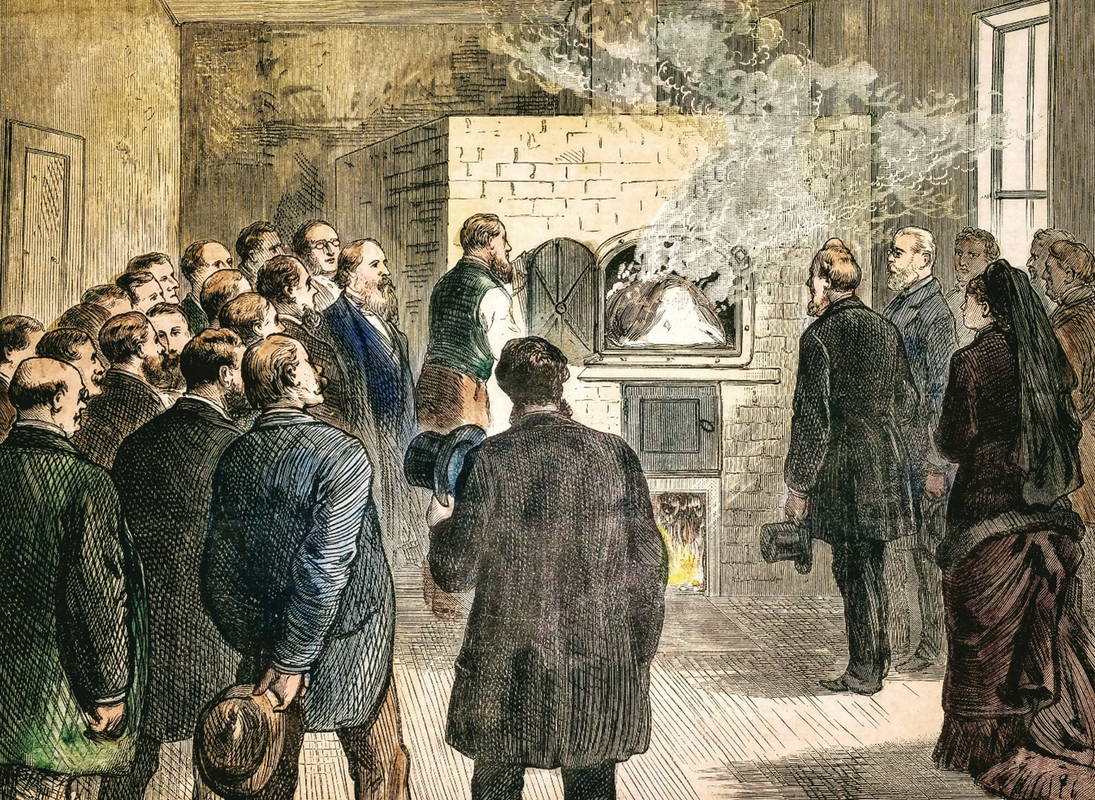
Not quite yet. Physician Francis Julius LeMoyne (1798–1879) was likewise convinced that runoff from decomposing bodies threatened public health, and he saw cremation as a potential solution. Around the time of the Baron's death, LeMoyne began building the first crematorium in the U.S., in Washington, Pennsylvania. It consisted of a coke-powered retort that reached temperatures over 2,000°F. According to a newspaper account, he ran a test on October 31, 1876—fittingly Halloween, though purely by coincidence—placing two slaughtered sheep in wooden coffins inside the oven. Within about thirty minutes, the contents were reduced to ashes.
On December 7, 1876, Baron de Palm became the first person cremated in LeMoyne's oven. Lengthy eyewitness accounts appeared in newspapers, and details were telegraphed to The New-York Herald. LeMoyne himself became the third person cremated there upon his own death in 1879. More than forty cremations were performed at the site through 1901.
As of 2026, LeMoyne's crematorium is still standing and open for public tours courtesy of the Washington County Historical Society. A sample of the Baron's ashes remains on display.
Chris Cascio is the Alan W. Rothschild Assistant Curator, Patent Models at Hagley Museum and Library.