
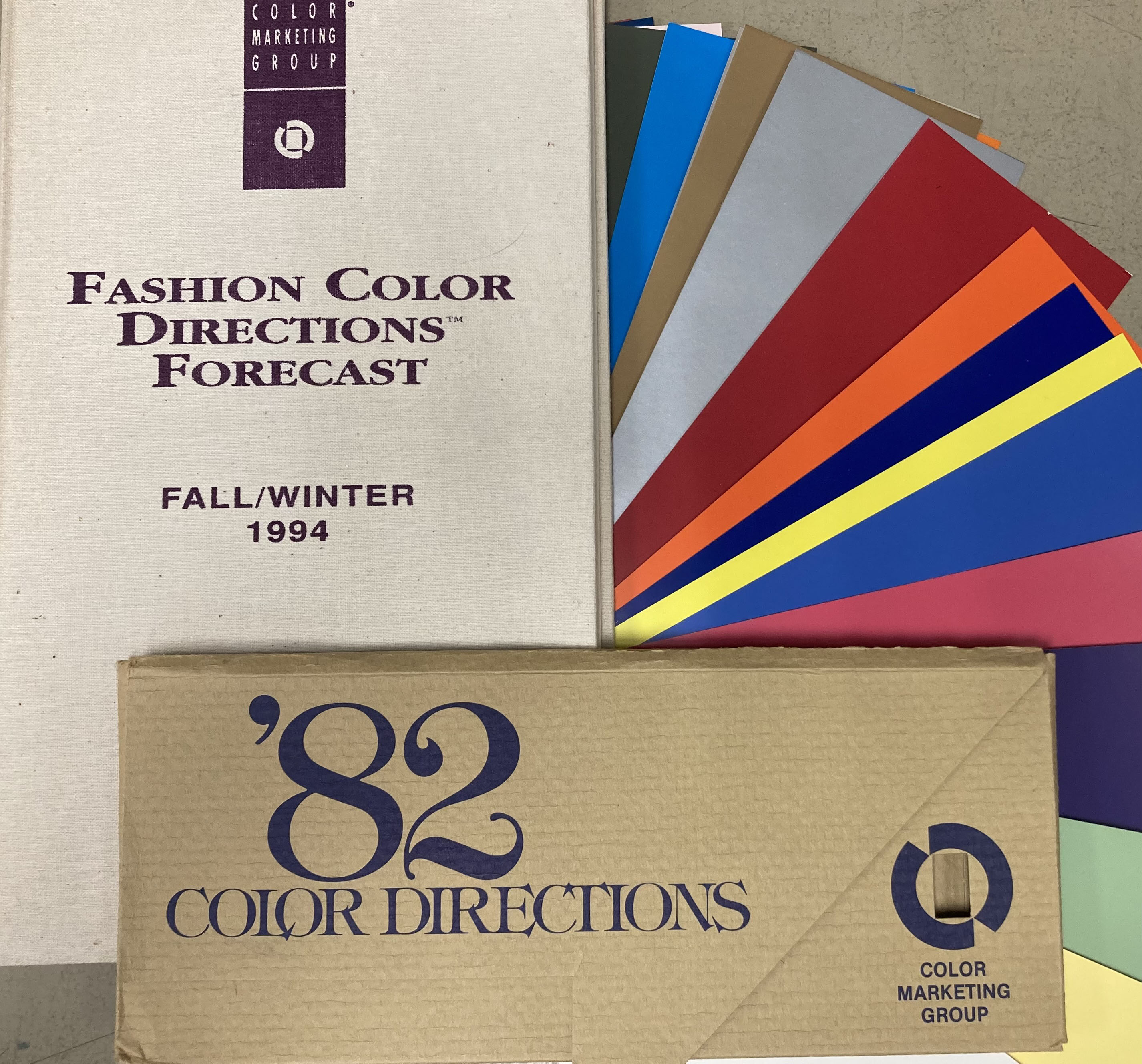
Last year I processed a fascinating new addition to Hagley’s extensive collections related to color studies—the Color Marketing Group (CMG) records. CMG is an international professional association founded in 1962 that focuses on color marketing and forecasting, color trends, and design. (Read a related article I wrote here.)
The collection contains many cards, chips, and samples of colors, some of them produced by CMG for use by designers and color professionals and some of them issued by manufacturers of various products to showcase available color choices. Flipping through all these colors was delightful—they really illustrate how color preferences have changed over time, from 1970s earth tones to 1980s neons, 1990s jewel tones, Millennial metallics and beyond
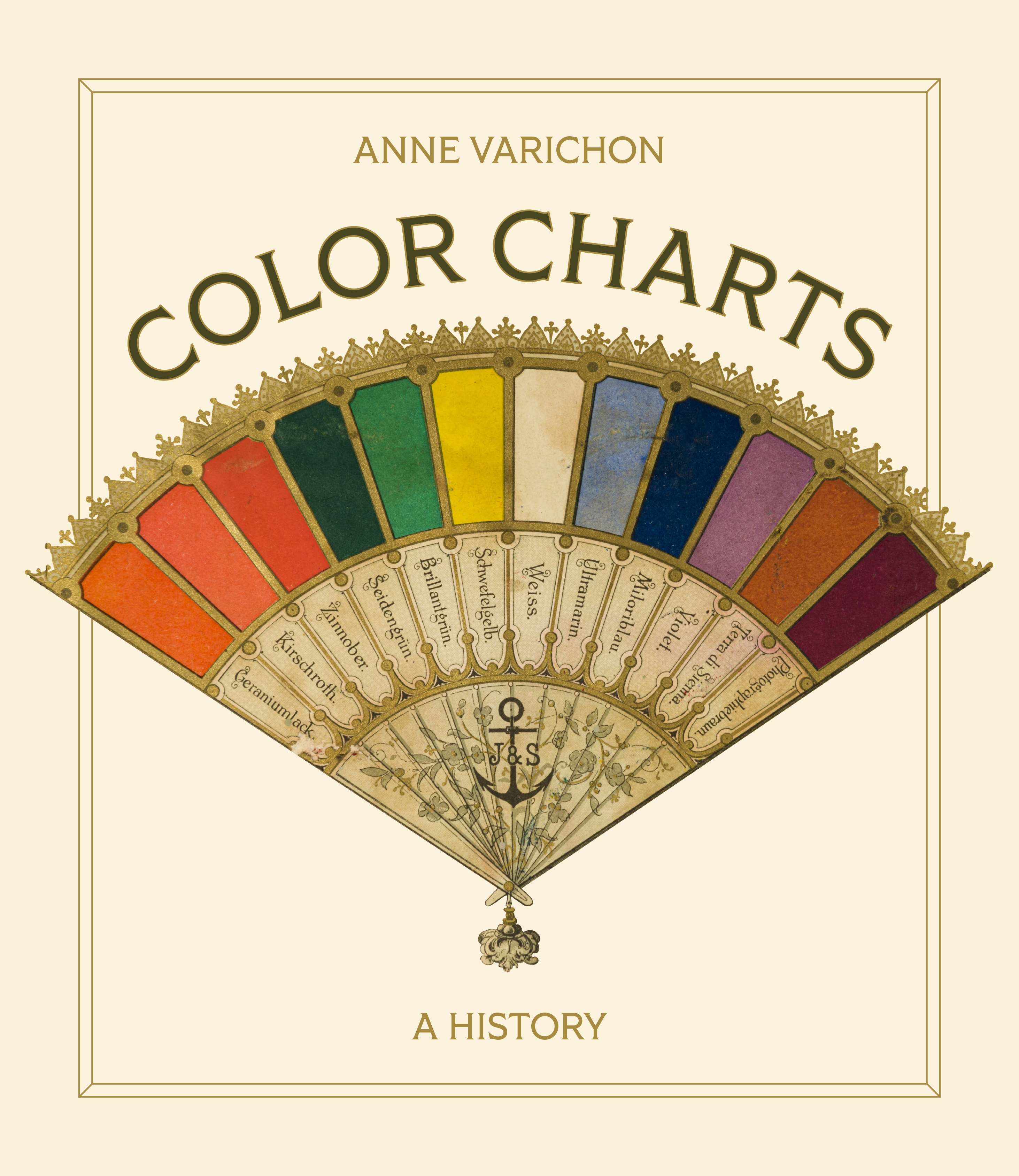
These CMG examples are part of a larger tradition of color charts: color presentation tools that can be used for color reference (for example, checking color accuracy) or color selection. If you’re like me and love standing in front of the walls of paint chips at Home Depot, you might enjoy a recent book by Anne Varichon, Color Charts: A History (Princeton University Press, 2024) (see cover below), that explores the evolution of color charts from the fifteenth century to the present day, presented in several hundred gorgeous illustrations.
Naturally, my attention turned to the many color charts here at Hagley! One of our flagship collections for the study of color is the Inter-Society Color Council (ISCC) records. The ISCC was founded in 1931 for the purpose of coordinating the activities of leading technical societies relating to the description, specification, and standardization of color and promoting the practical application of this knowledge in science, art, and industry.
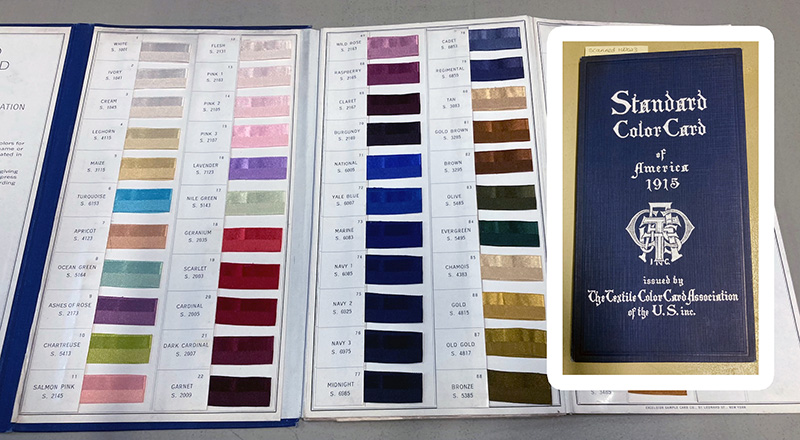
One such ISCC member was the Textile Color Card Association (TCCA), later renamed the Color Association of the United States (CAUS). The TCCA was organized in 1915 in response to the demand for a standardized set of staple colors to enable different segments of the textile industry and allied trades to coordinate their product lines. The TCCA's first standard color chart, comprised of 110 colors, was issued on May 21, 1915. It folds out from its rich blue cover in an accordion fashion, like a roadmap of colors.
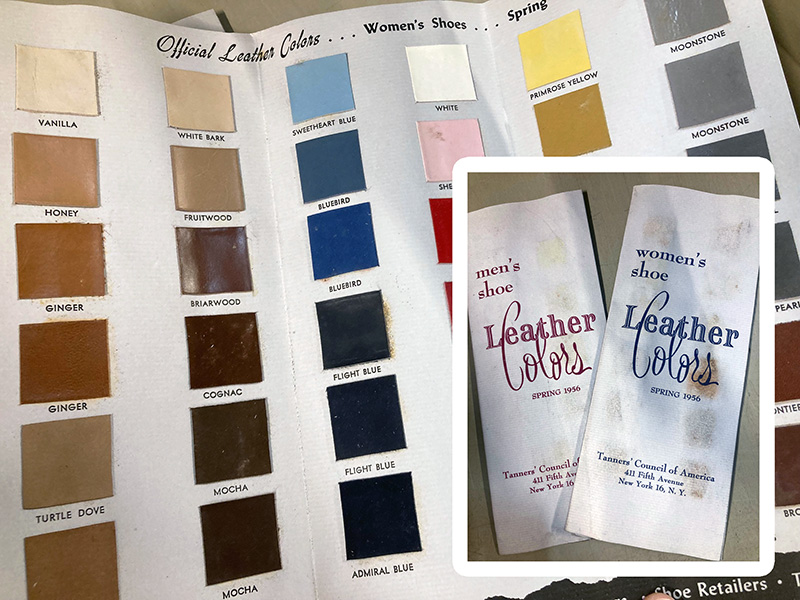
Color charts were produced for a wide variety of fashion industries: fabrics of all sorts, ribbons, trim, notions, hosiery, gloves, women’s wear, men's wear, and children's wear, as well as cosmetics. Also, beginning in the late 1920s, the TCCA worked closely with the federal government, particularly the armed forces, to produce standardized colors according to government specifications for use in uniforms, military ribbons, decorations, and flags. In 1952, the TCCA issued the first color chart for upholstery and drapery fabrics, and by the late 1960s, color charts covering the entire home furnishings industry were being issued.
America's burgeoning consumer culture after World War II made color coordination an increasingly important component for industries related to interior design, such as floor coverings, paints, wallpaper, and household appliances. After changing its name in 1955, the new Color Association of the United States expanded, shifting its focus beyond the fashion trades.
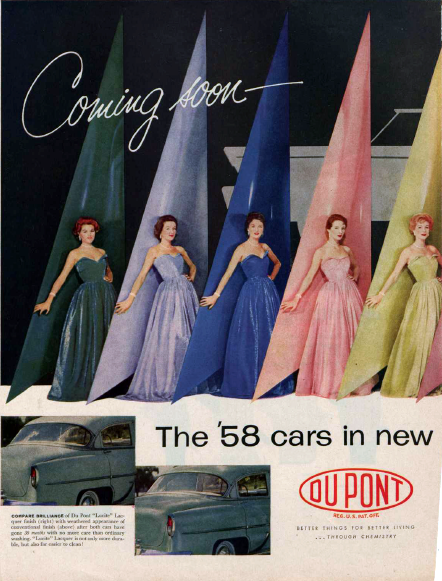
The DuPont Company issued color charts offering 1,600 shades available from DuPont dyes. Their colors, of course, came from trend forecasting conducted by CAUS. DuPont even wove color chart inspiration into its advertising campaigns, as in this ad for auto paints, which combines the rainbow hues of the 1950s color palette, the speed and forward energy of cars driving down post-war highways, and the sweeping fashion silhouette of dresses that required crinolines to hold their shape.
These are just a few examples that show off the best hues and shades of color charts! If you’re intrigued, you can explore more with our Color Studies research guide.
Diane E. Bockrath is processing and collections archivist at Hagley Museum and Library