
Hagley Library's Digital Archives are a constant work in progress ... we can't digitize it all, but we sure are trying! The latest addition to the Digital Archives is an expansion of an existing collection.
The images in the DuPont Company Engineering Department photographs collection has expanded with the addition of selections from the Wilpen subseries of the DuPont Company Engineering Department photographs (Accession 1982.300) collection.
The Engineering Department's roots in the company began in 1902, when it's predecessor, the Engineering Division of the High Explosives Department, was founded and tasked with the job of designing and constructing high explosives plants, expanding existing plants, and engineering industrial machinery for the purposes of manufacturing explosive powders. In 1911, this department merged with the Black Powder Engineering Division to become the Engineering Department.
This division became an especially crucial component of the company's operations during World War I, when the DuPont Company became a key defense industry in the war effort, the Engineering Department's staff did double-duty as members of the wartime DuPont Engineering Company, which handled wartime contracts for defense production.
Before its demise in 1928, the Engineering Department was tasked not only with the construction of plants handling explosives manufacturing and defense contracts, but also the manufacture of DuPont plants producing cellophane, synthetic fibers, paint, and dyes. The department also handled contract work for outside companies like the General Motors Corporation and the Wilmington City Marine Terminal.
This new batch of photographs from the files of the Engineering Department document DuPont's Wilpen Plant and largely date from 1911 to 1912. The plant was built to supply the mining industry around Hibbing, Minnesota with black powder explosives, used at the time to mine iron ore from the Mesabi Range mining district.
The company began building on the site between the city of Hibbing and the town of Wilpen on the Mesabi Road along the shores of Lake Carey in 1910, and the plant began producing black powder in October 1911. The site was served by a purpose-built railroad spur laid by the Duluth, Mesabi & Northern Railway connecting the plant to the region's railroad network. Wilpen was powered by an onsite power plant that sent steam-power to the industrial equipment used at various industrial buildings on the property.
The site consisted of twenty to twenty-five buildings, both industrial and domestic. The industrial buildings were connected by a narrow-gauge gravity railroad and trestles, fitted with brass to reduce the risk of sparks. The powder mill buildings were built out of concrete, often into the sides of hills and protected by bulwarks, and set at least 1,500 feet apart from one another to minimize damage in the event of explosions. This caution was warranted; work at the black powder plant was a dangerous job.
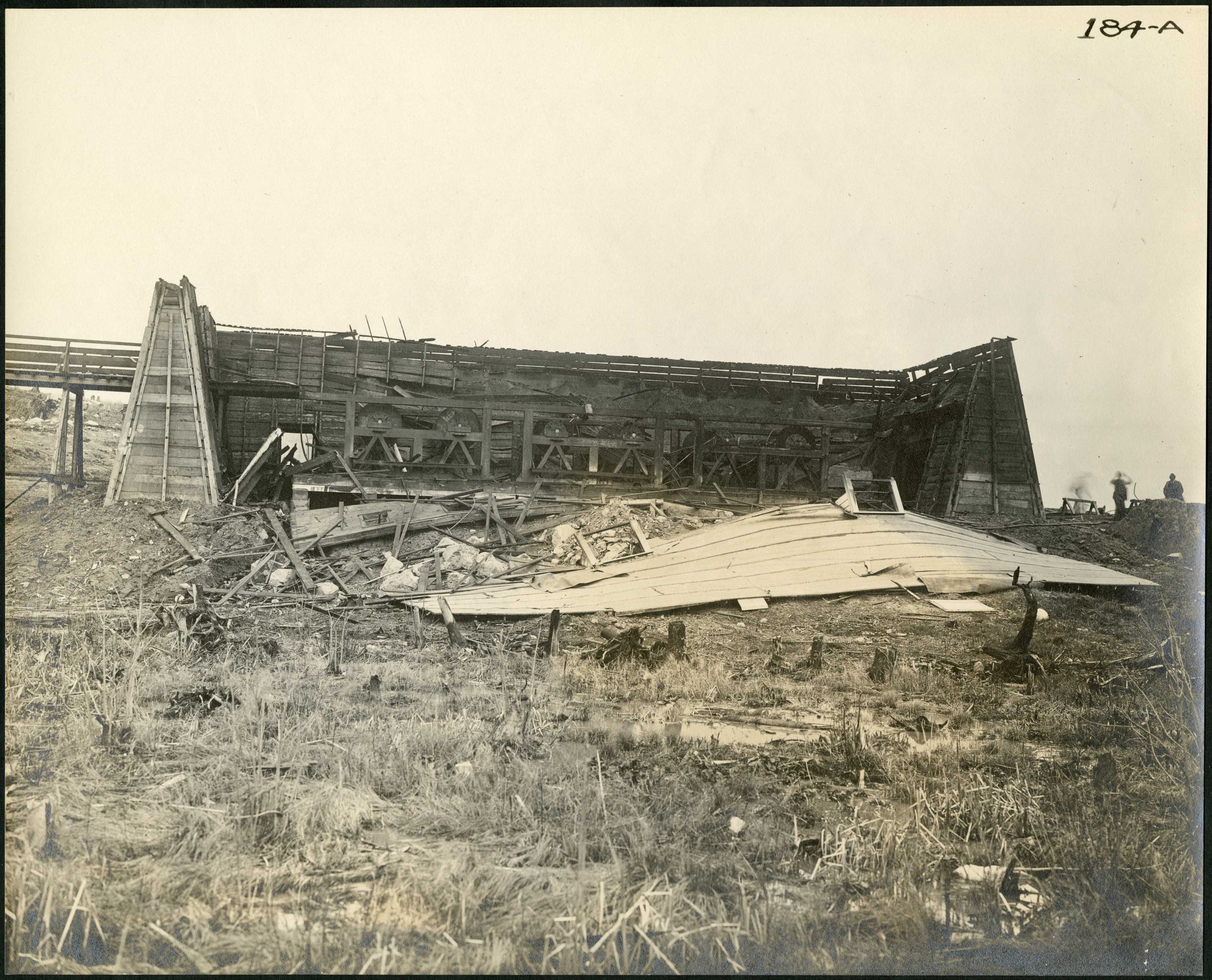
On January 11, 1912, an explosion at the plant's glaze mill (pictured) killed two workers, James Haley and Charles Winter. The aftermath of this explosion is documented in the collection, and selections from those photographs have been included in this new digital expansion of the collection. A short time later, the rebuilt glaze mill burned again when it was hit by lightning. Another explosion in the press mill on February 7, 1918 killed another two workers, Oscar Lehti and Kalle Jarvinenen. A final explosion in the glazing mill on October 12, 1918 killed Edward Ullman and James Perkins, the plant's assistant superintendent.
This last explosion marked the beginning of the end for the Wilpen Plant. World War I had provided an economic boost for the plant, as it took on contracts for defense work. But after the war, there was no significant government demand for black powder. Furthermore, the plant's customer base in the mining industry was already shifting to blasting with dynamite, which was safer to manufacture, transport, and store. By the time of this final explosion, the plant had dwindled to a workforce of forty men, almost all of whom were soon laid off.
In September 1919, DuPont also laid off it's animal workforce. The September 30, 1919 issue of The Duluth News Tribune reported that the company was looking to sell over 400 sheep that it had previously kept on site to clear land in order to prevent forest and brush fires around sensitive properties.
By 1921, the site was maintained only as a storage site for distributing black powder and dynamite to local markets, and by 1926, DuPont began dismantling the site to sell reusable materials for scrap. In the ensuing years, workers who had owned homes onsite left to pursue new opportunities. In 1929, the company intentionally burned down many of the remaining industrial buildings, as they were too contaminated with explosive powder to safely reuse for other purposes or to demolish by other means.
By 1931, little remained of the Wilpen Plant buildings, and DuPont sold the property to the Hanna Mining Company in 1967. The site was later annexed by the city of Hibbing in 1979, which created a park on the grounds and demolished what remained of the site in 2012.
To view photographs of the Wilpen Plant and associated properties from the DuPont Company Engineering Department photographs (Accession 1982.300) collection now, just click here to see them in our Digital Archives.
Skylar Harris is the Metadata and Digitization Coordinator at Hagley Museum and Library