
By the time this article is published, my internship will be over. I learned a lot during my 10 weeks at Hagley—especially the importance of careful, extensive research. Each day, I used online resources to research inventors and their patents. This article describes my most challenging research assignment and my process for uncovering its secrets.
 In 2015, Hagley received the donation of Alan and Ann Rothschild’s patent model collection – and summer interns like me have been processing the collection since. Professional art handlers packed each item carefully using the appropriate shipping materials. My job is to unwrap them and find out as much as I can about each model.
The first step after opening a new model is to look up its patent documentation online. This included the patent description and a drawing of the model. The simplest way to find this document is through the model’s patent number, which can be found on the invention’s patent tag. The patent tag is a government issued tag that was tied to model. Patent tags are about three inches square and include the name of the inventor, the title of the invention, and the date it was patented.
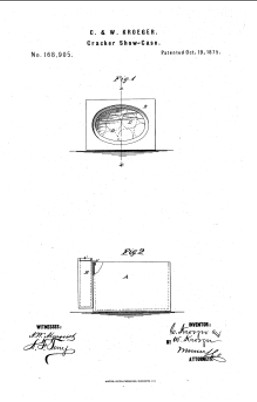
The tag that I unwrapped belonged to a cracker display case (patent drawing to the right). This drawing did not match the model, and the inventors’ names did not resemble the name painted on the side. Therefore, we had a mystery machine.
My first step in identifying this model was to find the inventor. Luckily, this model had a name written on the side. And while it was partially cut off both along the top and bottom of the inscription, it was legible enough to start research.
I started by looking up possible last names resembling the name on the model. After reaching several dead ends, I took a different approach.
Now this might sound silly. But desperate times call for silly actions.
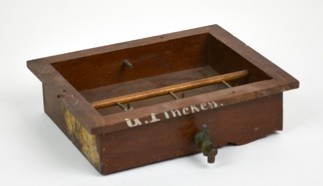
I typed in the search box, “what could a wooden hollow box with a rod and spikey points, with a spout on one side and a handle on another be?” After a little scrolling, information about a sugar draining apparatus came up.
A sugar draining apparatus aided in the process of refining sugar. Refining sugar strips away any impurities, along with molasses, and recrystallizes raw sugar. The models that resemble the one at Hagley included cone shaped molds that held crystalized sugar and had spouts, to allow the molasses to drain out.
I used that information to investigate sugar draining patents. This led me to an article from Scientific American magazine, of patent claims. One patent featured was an “Apparatus for Draining Sugar” , invented by Gustavas Fincken. The name “Fincken” closely matched the letters on the model.
After searching his name along with other sugar related patents, I found a patent document for a Sugar-Draining Apparatus, which improved “the process of Refining Sugar.” This patent drawing, while still missing a few features, resembled Hagley’s model:
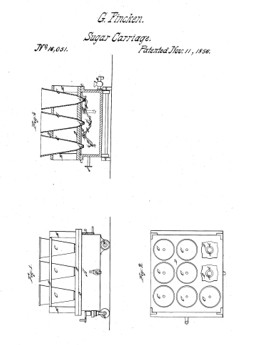
With the name and state of the inventor in hand, I searched other online sources and found two other sugar related patents assigned to him. I also found him in many other historical records including censuses, city directories, newspapers, along with his naturalization and death record.
Born in Germany, Gustavus Finken, moved to New York and became a citizen August 26, 1854, and worked as a sugar refiner. He earned two or more patents for the process of manufacturing sugar. He died around 1865 at only 32 years of age.
Not only did this inventor have the most interesting name of any inventor I researched, but the process of uncovering his connection to this mystery model was the most challenging and rewarding research assignment of my short time here in Hagley. This unboxing of a patent model taught me the importance of patience and persistence in research.
Cecilia Johnston is Hagley’s summer museum division intern funded by the Starr Center’s Explore America Internship Program at Washington College. She is currently pursuing a bachelor’s degree in business management, and her research focuses on patent models and their inventors.