
This summer, three tightly folded pieces of parchment arrived in Hagley's Library Conservation lab, each one a land document connected to the Penn family and Colonial Pennsylvania. Folded down to the size of a notecard and stiffened by three centuries of storage, none of them could be opened without risking damage to the parchment or the ink. Over the course of the summer, I had the chance to treat all three by relaxing their folds, stabilizing fragile ink, and finally letting them lie flat for the first time in generations.
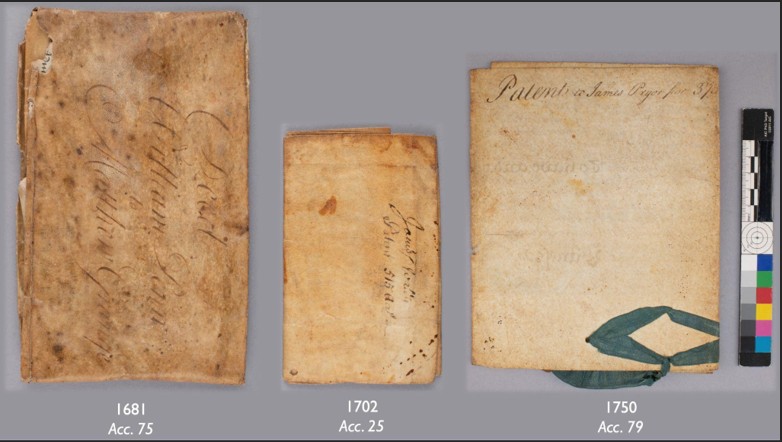
The earliest of the three, Accession (Acc.) 75, is a 1681 deed from William Penn to Matthew Grange, a farmer from Cheshire, England, for 100 acres of land. Its date, March 3, 1681, is a curious detail: it comes just one day before King Charles II's charter formally granted Pennsylvania to Penn. The document's wavy-cut top edge is an “indent,” a period security device; Penn's office would have kept a matching piece to authenticate the deed if needed later.
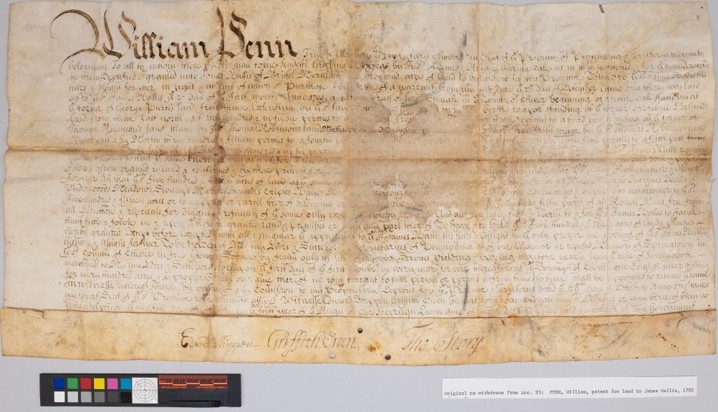
Acc. 25 is an October 1702 patent conveying 515 acres in Chester County to James Wallis, a Bristol merchant. That land later became the site of Longwood Gardens. Wallis's name also appears on a 1685 letter from Bristol Quaker merchants pursuing a debt tied to the slave ship Isabella, which brought the first enslaved Angolans to Philadelphia in 1684, a sobering thread connecting this land transaction to the broader history of the Atlantic slave trade.
The latest document, Acc. 79, is an April 1750 patent from Penn's sons, Thomas and Richard, confirming a resurveyed tract in Kennett Township to James Pryor. Witnessed by Lieutenant Governor James Hamilton, it shows the land passing through three generations of the same family before final confirmation, nearly fifty years after the original 1706 grant.
All three documents share the same conservation challenge. Parchment is made from animal skin, and its collagen fibers “remember” how they were folded, becoming stiff and resistant to opening over time. Forcing a fold open risks cracking the parchment or dislodging ink. In two of the documents, the iron gall ink used for the large opening flourishes proved friable, meaning ink particles could lift away from the surface with only light contact.
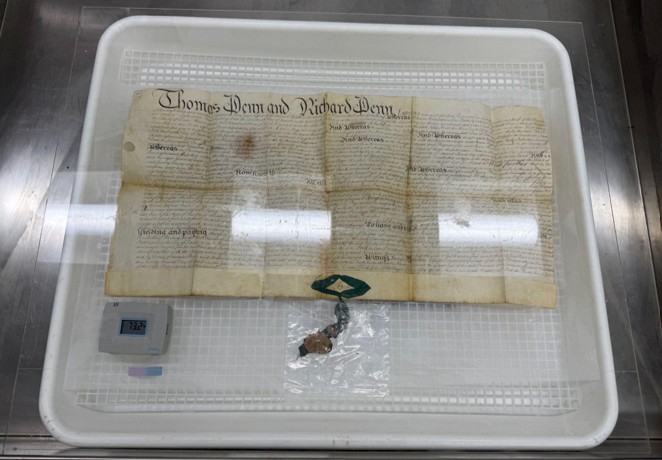
To safely open the documents, I built a humidification chamber using a saturated salt solution, which holds relative humidity at a steady, predictable level. In this case relative humidity was kept between 80–85%. This humidity was high enough to relax the collagen fibers without introducing enough moisture to mobilize iron ions beyond the inked lines. Each document rested above the salt solution on screen, monitored continuously with a hygrometer, sometimes for several hours at a stretch. The 1681 indenture, for example, needed three separate rounds of humidification over two weeks before its folds released enough for its creases to be reduced.
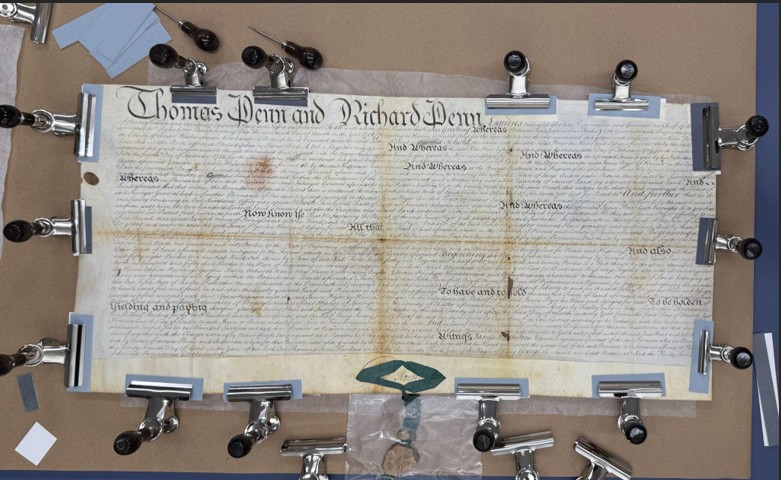
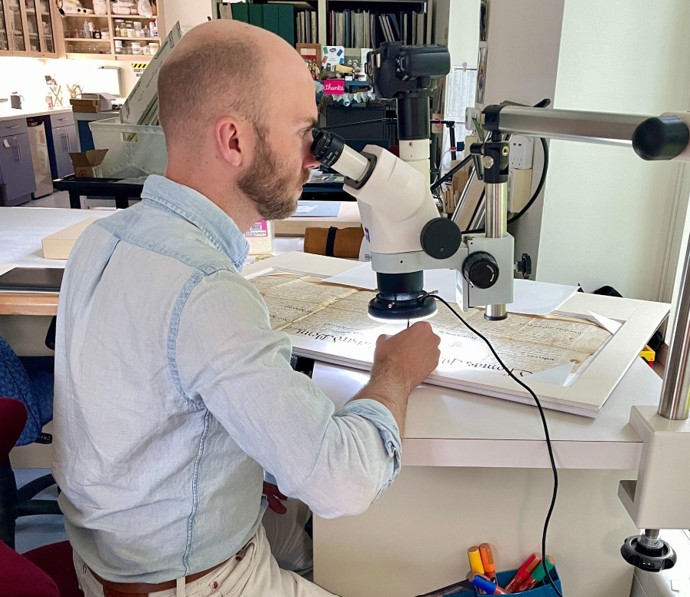
Once humidified, each document was dried under gentle tension. The edges of the humidified document were grasped with padded clamps and pinned to a board to keep the collagen fibers aligned as they dried and achieved a stable, flattened state. Where ink was unstable, I applied a dilute gelatin mist or brushed on Klucel G (a mild consolidant) under magnification to secure loose particles before further handling.
Rather than filling losses directly on the parchment, I built custom sink mat housings with padded wells for each document's seals and ribbons. Toned mulberry paper fills were adhered behind losses to a Tyvek-covered backing, restoring visual continuity without adhering new material directly to the historic object.
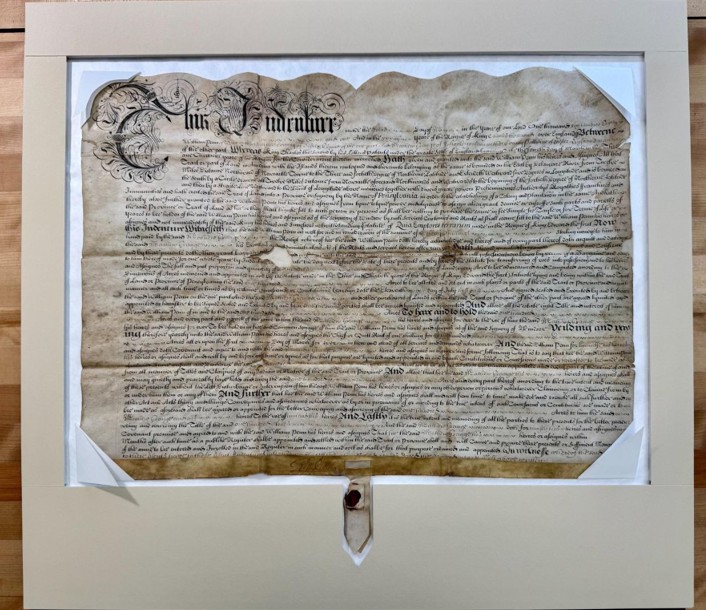
Seeing these three documents lie flat, legible, and safely housed after centuries folded shut was one of the most rewarding parts of my summer at Hagley. Each one carries its own story: a farmer's hopeful purchase on the eve of Pennsylvania's founding, a merchant's land grant entangled with the slave trade, and a family's decades-long effort to formalize their farm’s boundaries. Together, they're a reminder of how much history can be hidden inside a single folded sheet and how conservation can help unlock it.
Luke Kelly is the Conservation Summer Intern at Hagley Museum and Library. He is a rising third-year student in the Winterthur/University of Delaware Graduate Program in Art Conservation, majoring in Library & Archives Conservation and minoring in Paper Conservation.