
Hagley Library is always adding new material to its digital archives; one of the newest arrivals is the Official Guide of the Railways digital collection, a collection of over forty railway guides dating from 1848 to 1969, which were purchased by the library in digital format.
The majority of the collection is made up of a long-running series of guides published on a monthly basis under various titles by the National Railway Publication Company. The railfans reading this will know it on sight, though, as the essential classic that is commonly known as the Official Railway Guide and/or the Official Guide of the Railways.
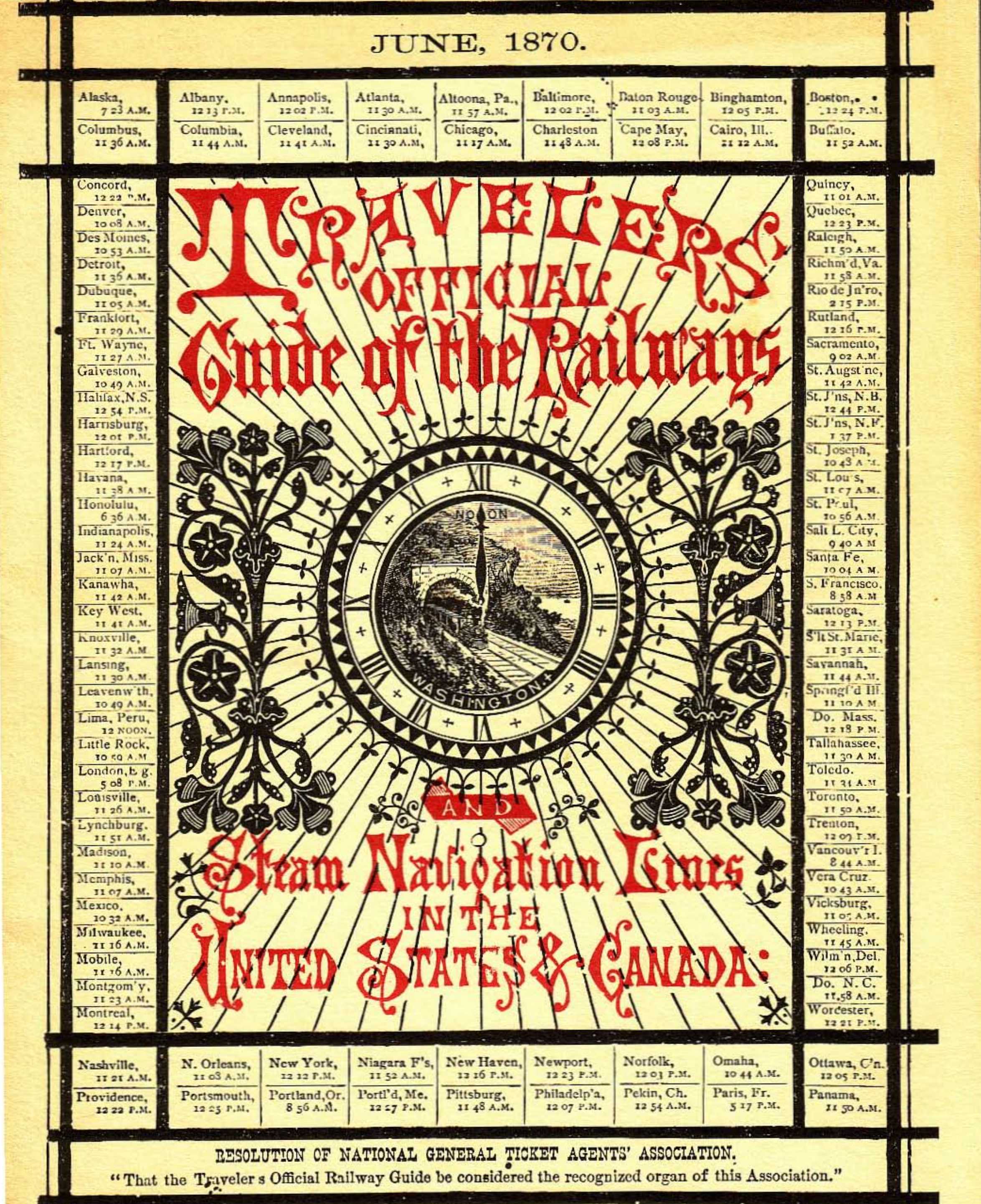
The seed for the publication was planted in October 1866, during a meeting of the National General Ticket Agents' Association, a professional association of general ticketing agents employed by American railroad companies that emerged in Pittsburgh on March 13-14, 1855.
At the time of its formation, the organization, then known as the General Ticket Agent's Association, declared that current practices surrounding the redeeming of railroad passenger tickets, were “an evil” that was prone to fraud and “imposition” that did a disservice to both passengers and railroad companies. The goal of the newly formed Association was to reform and professionalize these practices, in the interests of both business and passengers.
The General Ticket Agent's Association continued to hold meetings to further its goal, including a February 1856 convention that led to a reorganization as the National General Ticket Agents' Association. During the aforementioned October 1866 convention, the members discussed the “matter of a railroad guide”, in a “conversational manner”, and resolved to “confer and receive propositions” from members interested in taking up the challenge. Two members rose to the occasion.
In June of 1868, Edward Vernon (1830-1894), a General Ticket Agent for the St. Louis, Alton and Terre Haute Railroad, and Henry (H.H.) Wheeler (1836-1895), a General Ticket Agent for the Northern Missouri Railroad, published the inaugural edition of the Travelers Official Railway Guide of the United States and Canada, with Vernon listed as the compiler and editor of the volume and both men listed as joint proprietors of the venture.
Like the other members of the National General Ticket Agents' Association, both men had expressed dissatisfaction with extant popular guides, such as Appleton's National Railway Guide (also published under titles like Appletons' Railroads and Steamboat Companion and Appleton's New and Complete United States Guide Book for Travelers) and the American Railway Guide, and Pocket Companion for the United States, examples of which are also represented in this collection. Following the release of the publication, the National General Ticket Agents’ Association met in Cleveland, in June 1868, and resolved that the guide met the Association’s “approbation, in the main”, and resolved to support the publication.
Wheeler’s association with the publication would be short-lived. After 1868, he ceased to appear in the convention records of the National General Ticket Agents’ Association as either a representative of a railroad company or in association with the guide. When the Association next met in October 1868 and agreed to underwrite costs associated with publication of the guide, Vernon’s name was the only one discussed.
Based on available records, it appears that Wheeler’s life following this departure may have been a colorful one; on February 18, 1889, the St. Louis Post-Dispatch reported that an H.H. Wheeler whose age and family size roughly matched that of the H.H. Wheeler of the Travelers Official Railway Guide, had been working as the freight claim agent for the Wabash Western Railroad (which shared track lines with the Northern Missouri Railroad) for the previous eight years, but had disappeared from town, along with a “considerable sum” of the Wabash Western Railroad’s money.
Other reports the next day from the Kansas City Star allege he had been fired on “account of shortness in his accounts” and was “contemplating accepting a position in Canada”. Additional reporting on February 19th from the St. Louis Globe-Democrat included commentary from Wheeler’s general manager, who confirmed his departure, but aimed to quiet the story. Wheeler and his family reemerged by 1894, having joined Wheeler’s parents and siblings in Cleveland, according to a July 4, 1894 edition of The Cleveland Press, before his eventual death in October 1895.
Vernon’s life following the publication of the first guide is more straightforward; he continued to serve as editor of the Travelers Official Railway Guide until December 1, 1872, when he resigned the position. In 1873, he began publishing the American Railway Manual, a compendium of legal and operating information of the railroad industry intended to compete with Poor's Manual of the Railroads of the United States, but economic conditions were unfriendly to the venture, and it ceased publications in 1874. Vernon eventually returned to the railroad industry proper, taking a position as general freight agent of the Illinois & St. Louis Bridge & Tunnel Company and the Wiggins Ferry Company in October 1877.
The National General Ticket Agents’ Association, too, eventually moved on from the publication. The Association had become the General Ticket and Passenger Agents' Association in September 1872, the National Association of General Passenger and Ticket Agents in 1878, and the American Association of General Passenger and Ticket Agents in 1884. Their endorsement disappeared from its title pages of the guide, then being published as The Official Guide of the Railways and Steam Navigation Lines of the United States, Porto Rico, Canada, Mexico and Cuba, at some point after 1912.
The National Railway Publication Company, however, which had been formed for the purpose of publishing the Travelers Official Railway Guide, would continue with the publication for much, much longer. For over the next 100 years, the guide was published by the company on a mostly monthly basis (later editions were less frequent), and was an essential tool for railroad personnel and the tourism industry. The guide, which usually exceeded 1,000 pages per issue, contained comprehensive information about passenger train schedules of railroads across North and Central America, as well as connections to other forms of travel such as steamship lines and airlines, in addition to maps, information about important freight lines, directories of essential railroad personnel, indexes of railroad stations, and briefs on news on the railroad industry. 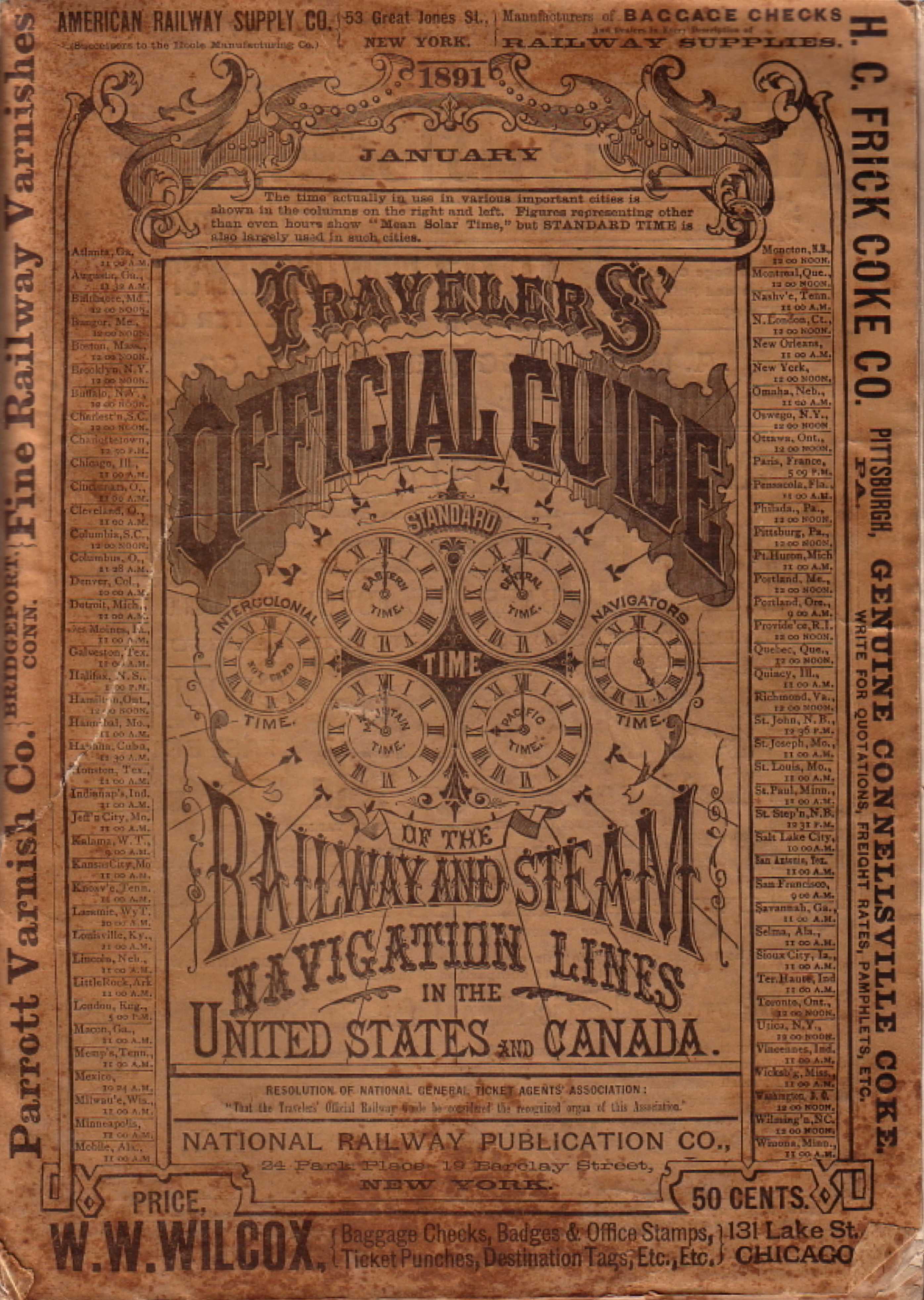
The impact the guide had on the railroad industry, and the country, during these years was considerable. Railroad companies consulted it when devising plans for construction of connecting lines and new track-work. The guide also contributed significantly to the lives of all Americans through the establishment of standardized time zones, which began appearing on the publication’s cover in December 1883 (see the 1891 cover featuring the standard time graphic, at right).
These standardized time zones had been established by the guide’s then editor, William F. Allen (1846-1915) at the request of the railroad industry, which was struggling under the burden of regularizing connecting schedules across an inconsistent series of time standards. In 1881, Allen proposed dividing North America into the four time zones in use today, based on the boundaries of the major commercial railroad interests. His suggestions were implemented in November 1883 for use by railroads, and eventually became the standard for the general public as well.
During the years that the guide was published by the National Railway Publication Company, it was subject to frequent renamings. A list of operating titles is as follows: Travelers Official Railway Guide of the United States and Canada (1868-1870), Travelers' Official Guide of the Railway and Steam Navigation Lines in the United States and Canada (1870-c.1896), Travelers' Official Guide of the Railway and Steam Navigation Lines in the United States and Canada and Mexico (c.1896-1900), Travelers’ Official Guide of the Railway and Steam Navigation Lines in the United States, Porto Rico, Canada, Mexico and Cuba (1900-c.1965), and the Travelers’ Official Guide of the Railway and Steam Navigation Lines in the United States, Puerto Rico, Canada, Mexico and Cuba (c. 1965-1974).
On January 1974, the publication shifted to a freight-only guide, published on a bi-monthly basis, with a guide to passenger travel being issued beginning that July through the company's Official Railway Guide, North American Passenger Travel Edition (c.1974-c.1979), which later became the Official Railway Guide, North American Travel Edition (c. 1979-1994).
But even the eventual demise of the company didn’t kill the publication. By the 1990s, the Official Railway Guide was still the company’s flagship title, but was one of many related publications (airline schedules, for example, had eventually spun off into a separate guide). The Official Railway Guide, along with other key publications, were eventually acquired by UBM Global Trade. Following a series of reorganizations and mergers, the asset remained in publication as it was passed through various corporate owners until August 2020, when its owner, IHS Inc., merged it with its own guide, the Pocket List of Railroad Officials.
You can visit the Official Guide of the Railways digital collection now in the Hagley Library Digital Archives. The Library also holds physical copies of the publication, including issues from June 1868, July 1877, and September 1877; the June 1869 Golden Spike Centennial issue; a June 1893 issue; an incomplete series of issues running from 1901 to 1971 (which also links to digital holdings outside of the Hagley Library); and a May 1983 issue.
Skylar Harris is the Metadata and Digitization Coordinator at Hagley Museum and Library