
The hustle and bustle of the holiday season tends to narrow our focus on traditions, trees, lights, decorations, and gifts. Some embrace it wholeheartedly, others reluctantly. Lest we forget, there are important moments in history that also fall on the calendar in December.
For example, Hagley Museum’s home state of Delaware was the first state to ratify the U.S. Constitution on December 7, 1787. That same date also marks "the day that will live in infamy" when the Japanese attacked Pearl Harbor in 1941. Rosa Parks refused to give up her seat on a Montgomery, Alabama bus in December. The U.S. Bill of Rights was ratified. The Wright Brothers proved the possibility of manned flight.
And 250 years ago, General George Washington and his ragtag army, who suffered a series of brutal and disheartening defeats in New York months earlier, surprised and captured a group of Germans fighting for the British at the Battle of Trenton. This victory boosted morale, convinced many soldiers whose enlistments were set to expire to rejoin the cause, restored public confidence, captured supplies that were crucial to the Army’s survival, and solidified Washington’s leadership.
Our modern lives seem so distant from those events. Yet, if one digs deep enough, connections to that important moment in American history are evident. Not one, but two patent models in Hagley’s collection, created nearly a century after those events, have ties to that critical battle.
On the night of December 25, 1776, Washington’s troops, pelted with sleet and snow, crossed the ice choked Delaware River and began advancing towards Trenton, New Jersey. Musket and cannon fire jolted the Hessians awake or stirred them from their posts. They hastily assembled to repel the American assault. One early riser, while shaving in the home of Stacy Potts, was shot through the window. The German commander, Colonel Johann Rall, desperately rallied his troops only to fall grievously wounded. He was carried back to his headquarters in the Potts house. He later died but was visited by Washington and General Nathaniel Greene before he breathed his last.
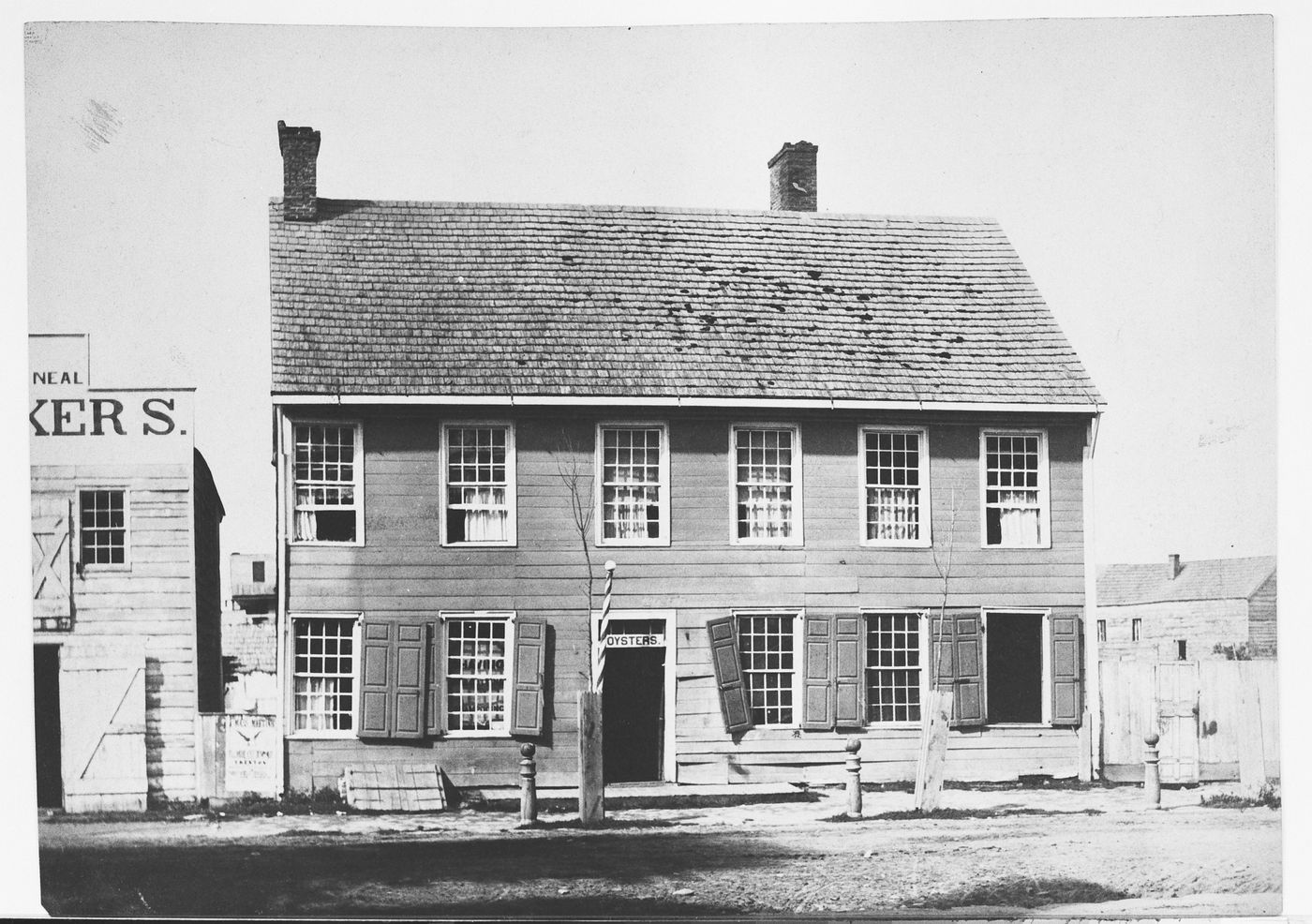
Later, the Potts house hosted Richard Henry Lee, President of the Continental Congress, when Trenton served temporarily as the nation's capital from November 1784 to January 1785. The Marquis de Lafayette visited Lee there in December 1784.
The house was torn down in 1857. But the pane of glass, pierced by the American musket ball that killed the grooming Hessian, is still in the collection of The Old Barracks Museum in Trenton.
The same year the Potts house was demolished, Potts’ grandson, Albert Potts (1823-1886), earned a patent for a method of signaling on steamboats. Its model, seen below, is in Hagley’s collection.
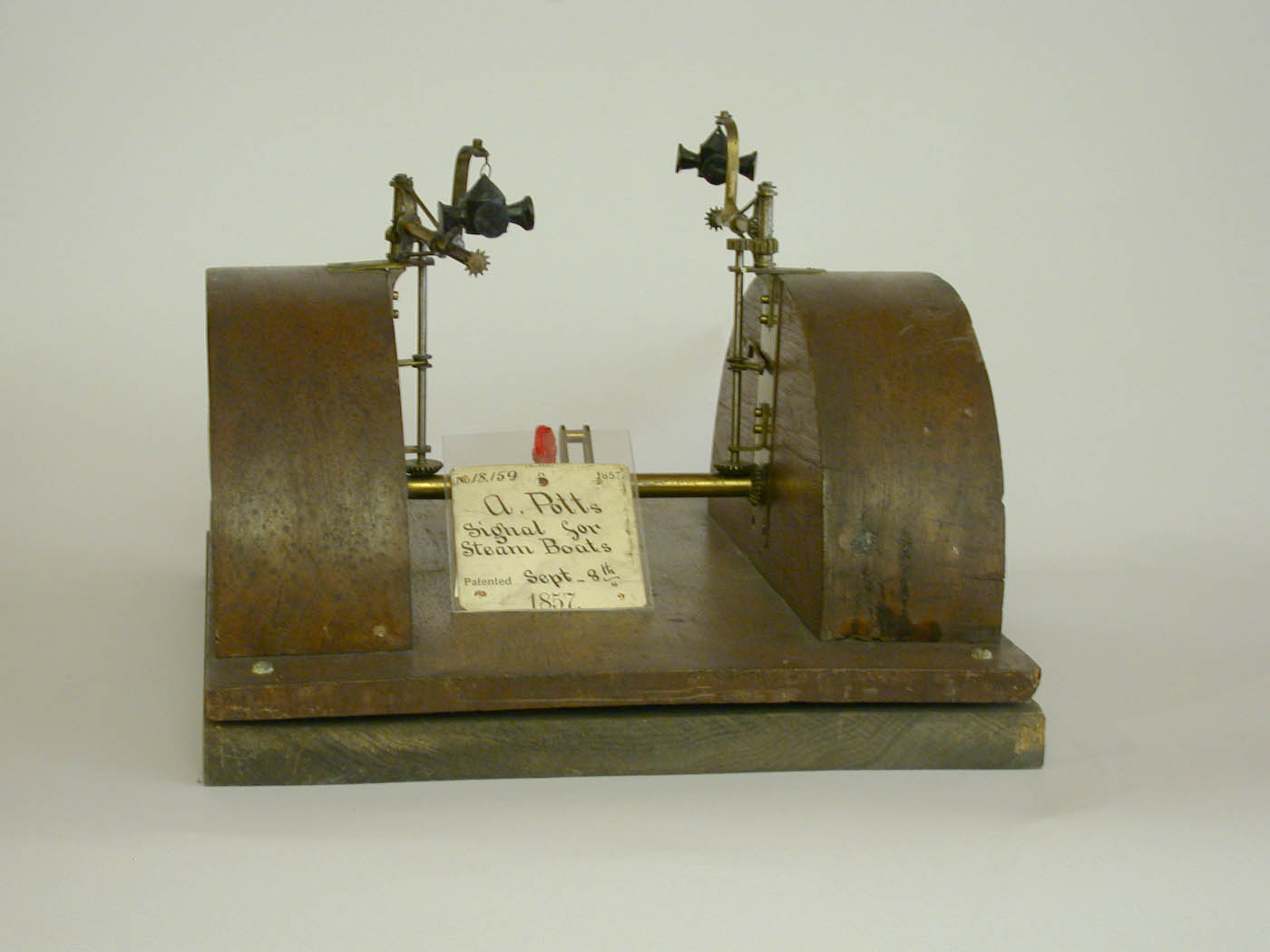
Potts invention added lights on poles above the pilot house of a steamboat. The poles could be raised or lowered by the pilot to signal other vessels. Each revolution of the engines spun the lights to make them more visible and indicate that the ship was in motion. Potts, an iron dealer and manufacturer, earned nine patents including one for a mailbox designed to attach to lamp posts. The U.S. Post Office Department purchased the mailboxes and marked the first street collection boxes put into use.
Around the same time Potts earned his patent, Adam Exton (1823-1887) emigrated from England and settled in Trenton. If there were any residual hard feelings towards the British in the community from the Revolutionary War, it did not harm his business. Exton established a very successful biscuit and cracker factory. He earned seven patents for the machinery that helped automate the process and is considered by some as the first to manufacture “oyster” soup crackers. His patent for a scroll biscuit machine from Hagley’s collection is pictured below.
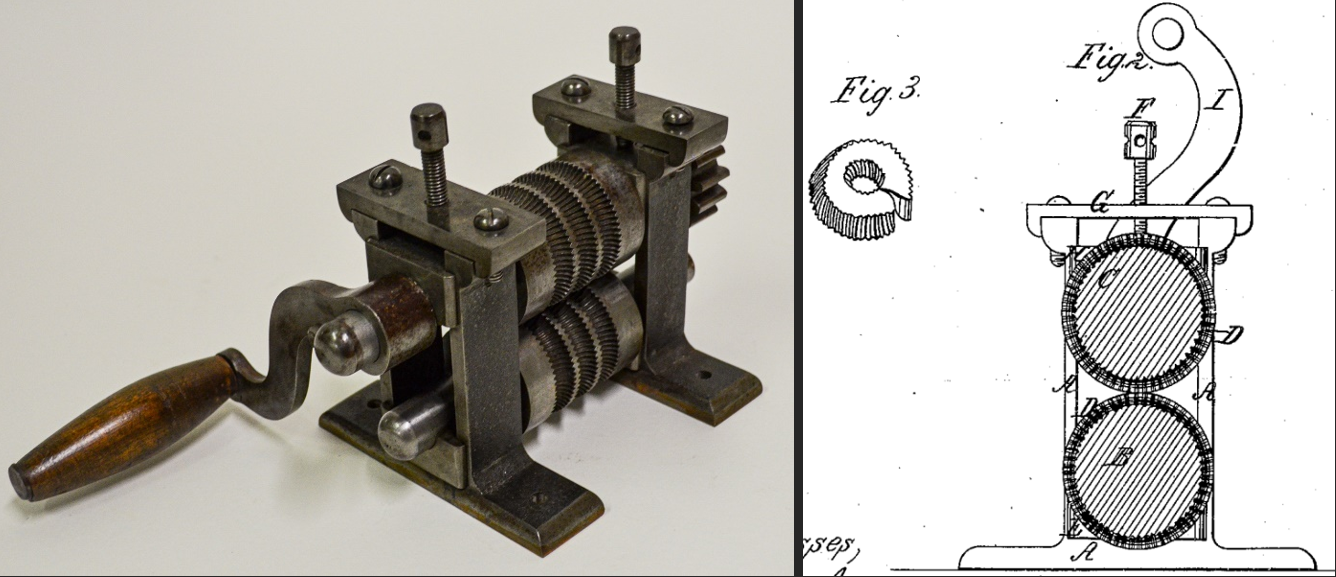
His machine cut “strips of dough [that] may be creased or figured for making scroll-biscuit.” He included a drawing of this donut-shaped biscuit, identified as “Fig. 3” above, as part of his patent application. Known as wine biscuits, or ciambelline al vino, these Italian treats were not only served with wine but traditionally included red or white wine in the dough. They received semi-top billing when his bakery was known as the “Exton Oyster and Butter Cracker and Wine Scroll Biscuit Factory."
Exton, like many immigrants, embraced and celebrated America becoming as ardent a patriot as any. Each Christmas, he convinced around 400 locals, including many of his employees, to cosplay in colonial garb and reenact Washington’s crossing of the Delaware River. Of course, he himself dressed the part of General Washington.
The holiday season can seem more like a curse than a blessing for some. Still, I hope that whatever you celebrate, be it Christmas, Chanukah, Kwanza, Bodhi Day, Festivus, or the Solstice, that you find peace, love, and joy. As for me, as a reenactor with the 1st Delaware Regiment, there is a good chance I will be following in Adam Exton’s footsteps (or oar strokes). My unit will be crossing the Delaware in reproductions of the same boats Washington’s army used on Christmas Day 1776.
Chris Cascio is the Alan W. Rothschild Assistant Curator, Patent Models at Hagley Museum and Library