
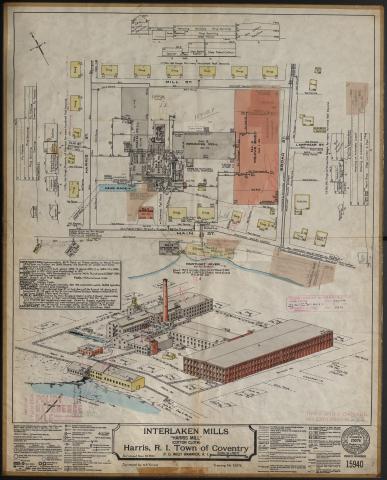
Here's a Vault post for all the savvy shoppers out there. The history of this 1932 fire insurance map for the Interlaken Mills textile factory dates back to 1835, when Zachariah Allen (1795-1882), owner of a woolen mill in Providence, Rhode Island, got fed up with his insurance premiums.
Rates had been rising for all mill owners during the economic depression of 1835, regardless of their individual history of losses or potential for future risk. In an attempt to reduce his burden, Allen appealed to his insurer, pointing out a number of innovative safety features he had implemented to reduce risk at his mills, which were some of the first in the nation to incorporate fire doors, sprinkler systems, and other built-in fire suppression devices. But to no avail.
So Allen started his own company, along with a team of other local mill owners who had also incorporated loss-prevention features into their operations. By 1836, the Manufacturers Mutual Fire Insurance Company was offering lower-premium insurance to factories in the Providence area that were assessed as being at a low risk of loss, with the promise that excess funds at the end of each year would be returned to policyholders.
By 1848, the operations expanded state-wide with the formation of the Rhode Island Mutual Insurance company. By 1850, Allen convinced a colleague in Boston to form the Boston Manufacturers Mutual Fire Insurance Company. Over the course of the next two decades, more manufacturing hubs created similar associations, eventually forming to become the Associated Factory Mutual Fire Insurance Companies.
Deciding which factories merited inclusion was an important part of operations - keeping premiums low was only possible if losses were limited. This was easier when the pool was small, as Allen and other local mill owners would have known the other policyholders in their area and known who shared their philosophies about risk and who didn't. But as the company expanded, a more formal process was needed, and by the late 1870s, the Associated Factory Mutual Fire Insurance Companies had formed a special division to inspect the factories and operations of their policyholders and applicants and to produce and distribute fire insurance maps and plans of individual insured properties like the one seen here.
By the time this map was created, the company had also expanded its operations to include conducting its own testing and research into fire safety, with a testing laboratory, an accreditation system for fire suppression and control systems, and a research team tasked with developing methods and devices that could mitigate property loss.
In the years after this map was created, the company continued to spawn and then consolidate individual local and regional mutual insurers, moving from a peak of forty-two smaller to companies to three larger ones, which finally merged in 1998 to form the Factory Mutual Insurance Company, or FM.
Hagley Library's collection of Associated Factory Mutual Fire Insurance Companies maps and plans (Accession 2087) is comprised of seventy original hand-colored plans and maps created by the company to insure textile mills, paper products factories and foundries in New England and New York. The maps include not only plans of the buildings themselves, but also maps of the infrastructure that supported them, documenting the urban water-main systems in New York, New Jersey, Pennsylvania and Delaware. The majority of these maps have been digitized and made available in our Digital Archives.