
For me, it started with a fig leaf.
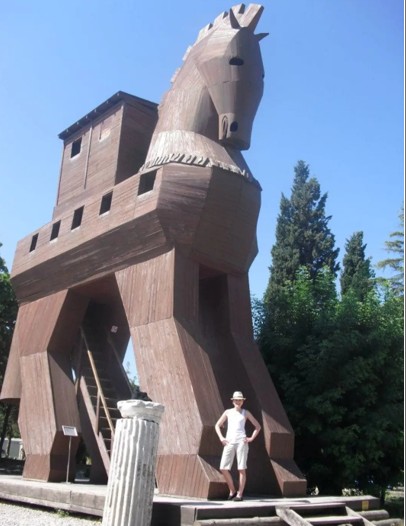 I plucked a fig leaf from a tree beside the Trojan Horse replica at Troy's ruins. The fragrant leaf went straight into my travel journal, labeled by hand. Later, spurred by my budding taste for plant-centered mischief, I took a poppy too. (Photo: The Author and a Replica of a Trojan Horse in Canakale, Turkey, 2012)
So began two weeks of botanical banditry across historic Mediterranean sites. By the time I boarded my flight home, my journal was packed with labeled contraband. Fourteen years later, those flowers and leaves remain as lovely and fragrant as ever. Photos were plentiful, but nothing evokes memories like those scented snippets of landscape.
My method of creating a souvenir skirted the edge of legality, but I'm not alone. Recently, I found a kindred spirit in the stacks. Mary Pauline Foster du Pont (1849-1902), known as Pauline, was the daughter of Herman Ten Eyck Foster and Mary Pauline Lentilhon Foster from New York. When her father died in 1869, Pauline traveled to Europe with her siblings. On her Grand Tour, she wrote three journals, documenting her travels daily. But her fourth "journal," like mine, was a different keepsake.
For centuries, people have preserved plant specimens with paper, weight, and patience. No special equipment or chemistry needed. By the Renaissance, scrapbooks called herbaria emerged, helping to spread the study of botany across Europe.
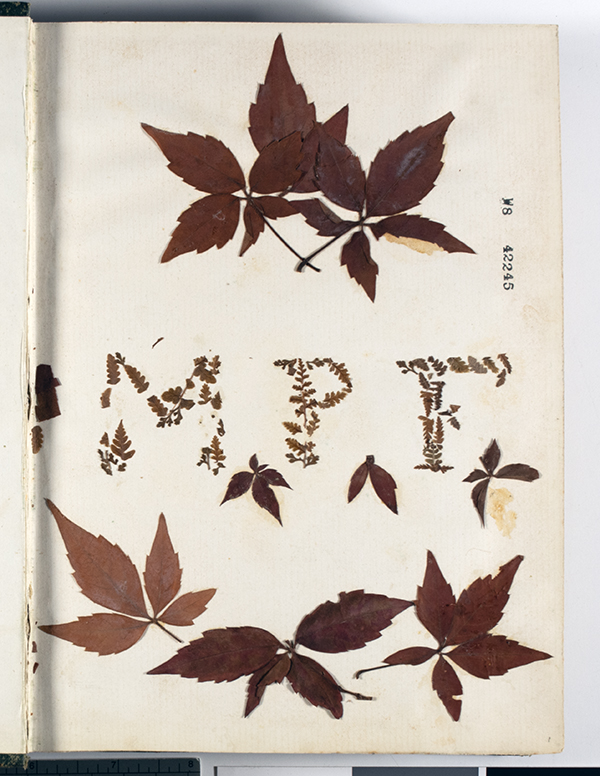
In the 19th century, fascination with flora became a fashionable hobby. Women, especially, found collecting and preserving plants accessible and socially acceptable. Today, historic herbaria are valuable archives that chronicle changes in vegetation, climate, and human impact; some even preserve seeds from extinct or endangered species. While many herbaria are simply collections of specimens, others are arranged artistically, like mine and Pauline's. Using pressed plants and feathers as 'paint,' artists create pictures—a technique called Oshibana, later introduced to the West.
A recent researcher's visit led me to Pauline's herbarium. Despite years in archival stacks, this was my first time finding a collection so much like my own. Her pressed specimens and handwritten labels form a vivid link between our stories and another era.
Sharon Folkenroth Hess is Reference Librarian at Hagley Museum and Library.