
Hagley Library’s newest Digital Archives addition is a small but effervescent look at the history of advertising. The Pepsi-Cola Company 1977 Black Community Marketing Handbook (Accession 2883) offers a brief glimpse at the soft drink company’s history of engagement with Black American consumers.
That history began a few decades after the company’s founding. PepsiCo, Inc., now an American multinational food, snack, and beverage corporation, got its start in Bradham’s Pharmacy, a small business operated by Caleb Bradham (1867-1934) in New Bern, North Carolina. Bradham invented Pepsi-Cola, which customers initially called "Brad’s Drink," in 1898 as a digestive aid. It’s popularity convinced Bradham to leave the pharmacy business and devote his energies to marketing the product full-time, launching the Pepsi-Cola Company in 1902.
 Bradham retained control of the company until 1923, when financial losses led to its bankruptcy. The brand’s assets were then sold to Wall Street financier Roy C. Megargel (1877-1935) who soon after sold it to Charles Guth (1877-1948), president of the Loft Candy Company.
Guth’s tumultuous reign over the brand ended when the Loft Candy Company successfully sued Guth after they discovered he had used company assets and facilities to rebuild the Pepsi brand, but refused to share the proceeds or the recipe with Loft Candy. The final verdict resulted in the soft drink company leaving Loft Candy’s ownership and Guth being replaced by Walter Staunton Mack, Jr. (1895-1990) as the president of Pepsi-Cola, Inc.
Walter Mack’s most notable legacy as executive was the implementation of an aggressive marketing campaign that explicitly targeted Black consumers. This was an unusual choice at the time. Pepsi’s primary competitor, Coca-Cola, like most national brands , had studiously avoided linking their products to Black consumers over fears that this would lead white consumers to view the product as inferior or be otherwise tainted by racist associations.
Mack, however, saw this as an opportunity to tap into an under-served consumer group. In 1938, he created a “special markets” division of advertising professionals called the "Negro Markets Division" to create a promotional campaign and on-the-ground sales team. This team included two of the nation’s most successful Black advertising executives, Herman T. Smith and Edward F. Boyd (1914-2007). The division also hired a number of other notable Black professional staff, including Harvey Russell who later became a vice president at the Pepsi-Cola Company, making him the first Black vice president of a major U.S. corporation.
Smith, Boyd, and the other division staff launched an advertising campaign that ran in Black newspapers and other media. Advertisements featured celebrities such as famed bandleader and pianist Duke Ellington, Nobel Prize winner Ralph Bunche, and other prominent Black Americans, as well as generalized images of Black doctors, educators, and other depictions of the Black professional class. The division also sent Black sales representatives throughout the Jim Crow South to visit bottlers, civic groups, community institutions, and other relevant stakeholders.
 During the years when the Coca-Cola Company was resistant to hiring Black professional employees and its chairman was publicly endorsing the reelection campaign of Georgia’s segregationist governor, Herman Talmadge, Pepsi’s special markets division was reaching out to Black consumers with the argument that their employer was a different kind of soft drink company. As a result, Pepsi’s sales increased significantly with Black consumers, who purchased it over Coca-Cola by a rate of 3:1.
But the campaign eventually came to an end. Walter Mack faced push-back regarding the campaign, with one 1947 memo detailing concerns that the effort to build brand loyalty among Black consumers had led to Pepsi becoming perceived by white consumers as a “negro drink." When Mack left the company in 1951, concerns about how white Americans viewed the Pepsi brand took center stage. The advertising campaign run by the Negro Markets Division was discontinued and the marketing team was disbanded, with most of the employees that stayed with the company reassigned to regional sales teams.
By the time the company created the 1977 Pepsi-Cola Black Marketing Handbook, it was no longer at the forefront of advertising to Black consumers. A number of notable national brands had begun pursuing the demographic as a market in the 1950s and 1960s, not long after Pepsi-Cola shuttered its Negro Markets Division. Coca-Cola had begun running ads in Ebony magazine in 1953 after hiring its own Black advertising executive, Moss Hyles Kendrix (1917-1989). And while the legacy of Mack’s outreach had kept the brand a popular choice for many Black consumers, Pepsi-Cola's hold on that customer base was declining, with a significant drop-off in brand awareness and preference after 1973.
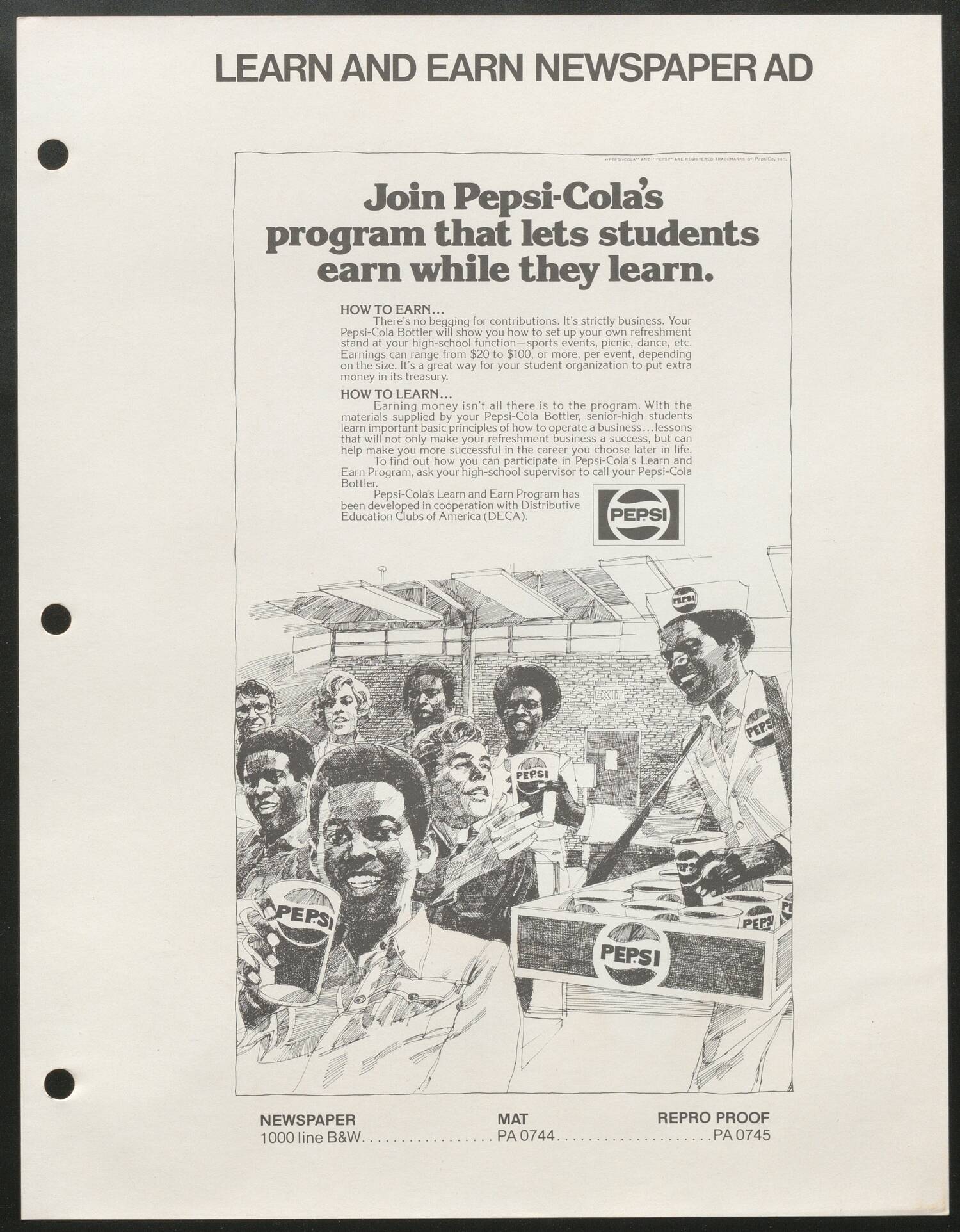
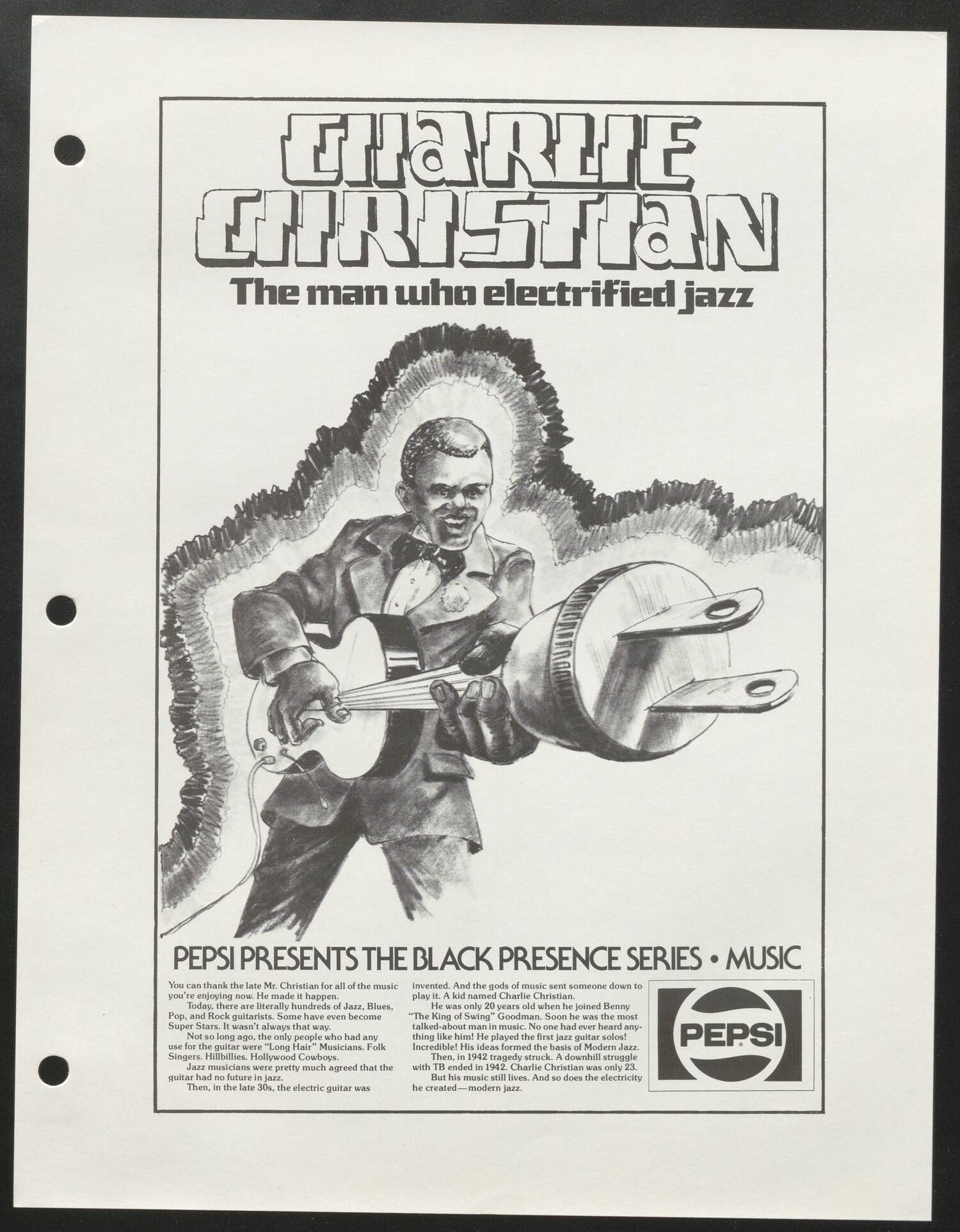
In response, the company created a new advertising campaign as well as a marketing handbook that it distributed to local bottlers and regional branches. The campaign, which is outlined in this new collection, involved newspaper ads, consumer promotions, radio advertising, and community service programs. You can view this handbook, a cover letter distributed to bottlers, and a guide to one of those community service programs online now in our Digital Archives.
Skylar Harris is the Metadata and Digitization Coordinator at Hagley Museum and Library