
Despite completing the curation of Hagley's recent "Innovation in Miniature" exhibition, I continue to enjoy serendipitous findings in the William Pahlmann Associates papers. I especially love learning about the human connections Pahlmann had with other influential designers. This group portrait of the Dorothy Liebes Studio weavers, circa 1946, is one of these discoveries:
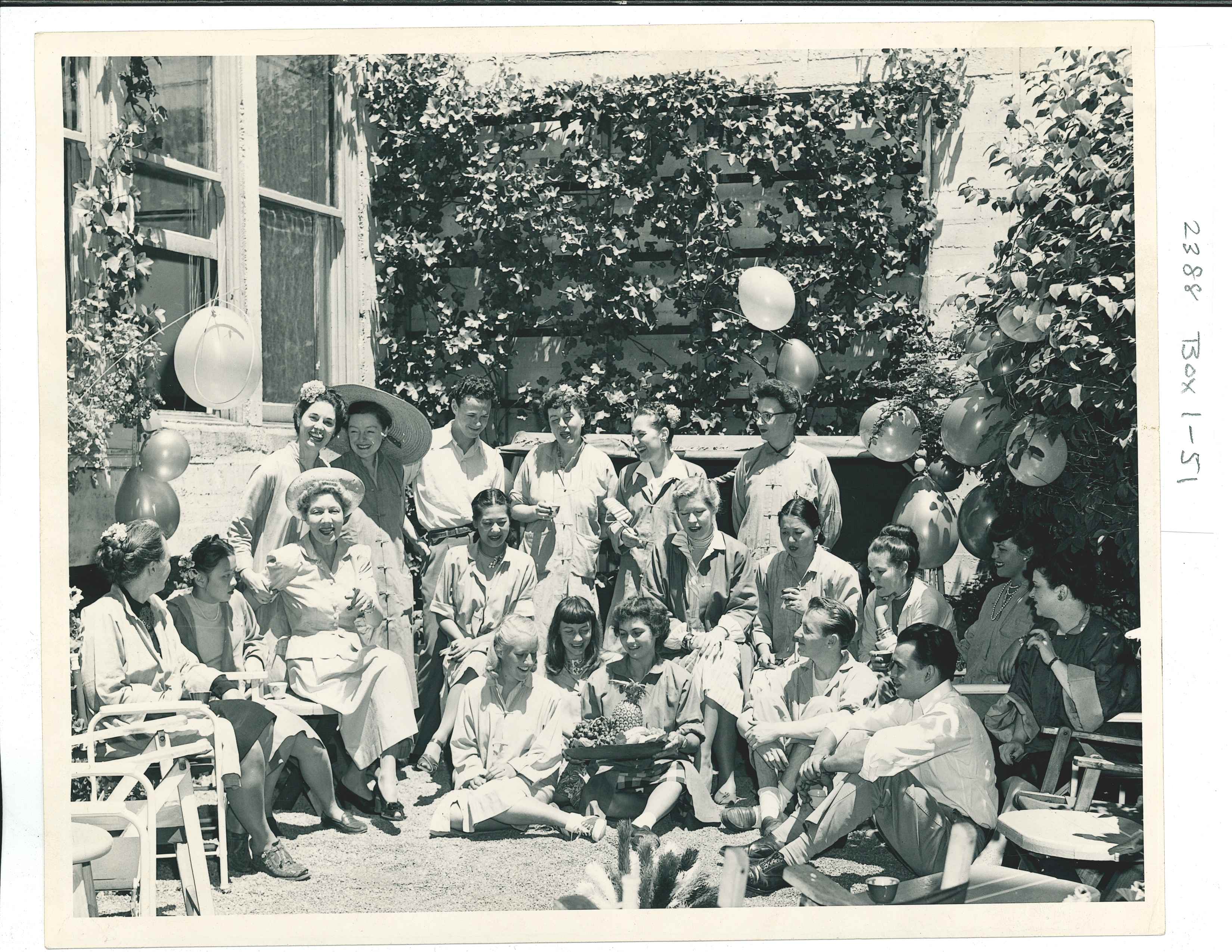
Dorothy Liebes's (1897-1972) San Francisco, California weaving studio opened in 1930, producing hand-wovens for private commissions. Window blinds, upholstery, and rugs were part of their portfolio of products. Liebes was a creative experimenter who never restricted her work to a limited color palette. Most certainly she would have been turned off by the drab home textile selections seen at big box stores today! She loved to explore various textures and sheens and chose to incorporate natural and synthetic components from straw to cellophane to metal threads and glittery Mylar. This willingness to try synthetic fibers and plastics led to a natural collaboration with the DuPont Company. Orlon acrylic, rayon, Antron Nylon, and Nomex nylon, are some of the DuPont manmade fibers that she used.
While power looms were the key to making Liebes's designs affordable, it was the DuPont marketing efforts that made them accessible, allowing for the broad reach of her studio's work. In the 1950s, the Liebes name became famous for her work associated with corporate-designed, mass-produced carpets and rugs. The artists creating these designs used tufting guns to make prototypes of their patterns. A pamphlet from DuPont's Wonderful World of Chemistry stage production at the 1964-65 New York World's Fair even credited Liebes with the curtain design. Both Dorothy Liebes and William Pahlmann's (1900-1987) careers initially grew from support of wealthy and exclusive clients, but later their success came from producing and expanding designs and products to the mass market consumer.
When I found this group photograph in the papers of Pahlmann Associates, I immediately recognized several faces that regularly occur in the collection: Dorothy Liebes is seated in a white hat, pointing at the camera; Tammis Keefe is seated behind the young lady holding the pineapple; and Daren Pierce is second from the right in the front row.
Tammis Keefe was a designer of graphic textiles, who found success producing quirky and colorful images for kerchiefs, kitchen towels, and curtains. Daren Pierce was a significant connection between Liebes and Pahlmann. A textile designer, he probably learned weaving from the American Red Cross Arts and Skills Corps. program after serving in World War II. Pierce began work as a weaver for Liebes in 1945, moving to the New York City studio in 1948 and staying until he left for employment with Pahlmann Associates in 1949. There he settled in as one of several professionally accredited designers at the firm.
By visiting the Cooper Hewitt Museum Exhibition website for "A Dark, A Light, A Bright: The Designs of Dorothy Liebes," I was able to identify some other characters in the picture. On this page, I found a photograph of the Liebes studio workers in 1946. It has about six faces matching those in Hagley's picture. College friend Ruth MacKinlay (wide brimmed straw hat) was Liebes's first business partner. One of her first employees was Louise (Louisa) Fong, whose eldest daughter Vanita also became an employee. Louise (seated next to Tammis and behind Daren) did a variety of tasks but was primarily the bookkeeper. She continued working for years in California after 1947 when Liebes opened a second studio in New York.
Pahlmann and Liebes were both located in New York, and they continued a long association that was both professional and social. Goodall Fabrics by D. Liebes were used by Pahlmann, and his name appeared in advertisements for their products. Both were members of the National Art Education Association, and Liebes attended private parties held by Pahlmann, all documented in photographs and papers at Hagley.
DuPont sponsored a 1970 retrospective exhibition of Liebes's work at the Museum of Contemporary Crafts in New York. Letters Pahlmann wrote to encourage the exhibition are found in the archival collection at Hagley Library. Dorothy Liebes passed away two years later a lifetime of innovative textile design and advocacy for the arts.
Laura Wahl is the Library Conservator at Hagley Museum and Library