
As I write this, the First State is in the throes of its usual early spring weather whiplash. You know that time of year when Mother Nature just can't seem to make up her mind? The list includes first spring, second winter, false second spring, third winter, first false summer, actual spring, interrupted by flood and mud seasons! While our ancestors endured similar weather shocks, springtime in the 19th century brought on another tradition many of us have wisely abandoned: deep spring cleaning.
During winter, homes were shut up tightly. Some sequestered themselves in only one or two rooms the entire season to conserve warmth and fuel. The furnaces, heat stoves, fireplaces, and oil lamps burned for longer hours. Soot from these devices accumulated on everything from chandeliers to the backs of paintings. Dust and dirt encrusted every surface and filtered into every nook.
Sometime between March and May, when it was warmer but there were fewer insects, every door and window were flung open to let in a blast of fresh air. Then the drudgery commenced.
Entire rooms were emptied. Shelves and cupboards were laid bare. Furniture—as well as husbands and children—were piled out on the lawn. Then every surface was cleaned. Every rug, carpet, and window treatment were taken up or taken down. Stoves were disassembled, cleaned, and sometimes stored elsewhere for the summer. Every utensil was scoured, every book and knickknack dusted, and every dish washed. Many mattress ticks were emptied, laundered, and restuffed.
It was an enormous task. Women, who did all the work, expressed their contempt by describing it as "a household earthquake," a "terror," and an "abomination." One can at least hope that they were satisfied with the results. After calculating the effort and costs involved, however, poet Emily Dickinson disagreed, saying "I prefer pestilence."
Men dreaded it too. One exasperated woman recalled that spring cleaning "broke women's backs and caused men to break the Ten Commandments." Husbands returned from a long day in the factory or the field to a cold meal and choreographed chaos. Those who remained in the home were chased from room to room. Clergyman and abolitionist Henry Beecher Stowe bemoaned how the process dictated "what you must wear, where you may sit down, what you may touch." Further, he pined for not only a return to normalcy, but for "a morsel of dirt for luxury…a plowed field with endless dirt—all hail!"
Seeing as spring cleaning (not to mention cleaning at any other time of the year) was such a brutal chore, inventors patented devices to make the process easier. Recently, this patent model for just such a cleaning tool was donated to Hagley's collection.
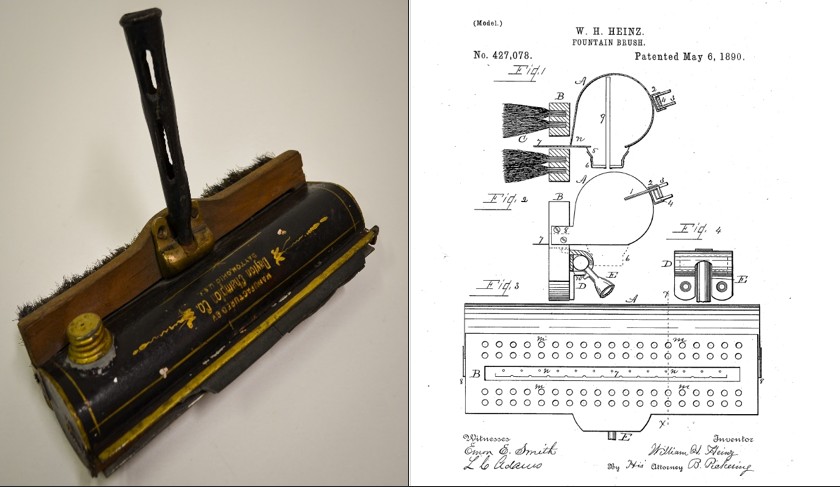
It is called a "fountain brush" because, like a fountain pen, it has a refillable reservoir for the preferred cleaning fluid. This invention included a brush for scrubbing as well as a rubber squeegee blade at the front. A diagonal socket accommodated a handle of the appropriate length to reduce stooping and the necessity of a ladder to reach the upper panes of glass. The manufacturer's stamp (below), seen in gold paint on the front, reads: "Manufactured by/Dayton Champion Co./ Dayton, Ohio U. S. A." This company specialized in manufacturing farming implements and agricultural machinery including its popular "Dayton Champion Sulky Plow".
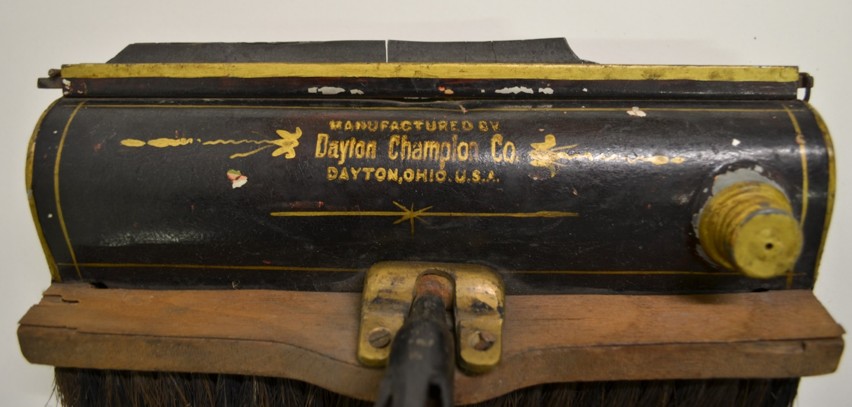
Unlike many of the inventions represented in Hagley's patent model collection, both the manufacturer's stamp and historical records prove that this tool was actually manufactured and sold to the public. The inventor, William H. Heinz (1848-1919), worked as a dry goods merchant in Dayton, Ohio. He and Charles E. Wilson founded the National Window Cleaning Company in 1898 to market and manufacture his invention. Wilson left the company, but Heinz pressed on earning another patent for a tool designed exclusively for cleaning windows. When his wife died in 1899, he was described in her obituary as an "active and successful businessman." His entry in the 1900 U.S. Census lists his occupation as a "manuf. of window cleaners." Heinz continued the business until around 1908 when he and his adult children moved to Seattle, Washington. There, he worked alongside his son as a fire insurance agent and real estate investor.
One would assume that all the innovations created during the Golden Age of Invention throughout the last half of the 19th century provided women with more free time. Fact is that the introduction of new "timesaving" technologies often had the opposite effect. Devices that made the home easier to clean just redefined what it meant to have a "clean" house. Societal expectations changed so that tasks that were scheduled for once a month, or even twice per year, were performed weekly or even daily. Sure, inventions such as vacuum cleaners, washing machines, and sewing machines meant that women could complete tasks faster, but that just led to more sweeping, more frequent laundry, and more sewing. They were still locked into the never-ending cycle of unpaid daily household drudgery. And for all our progress, few of the millions of patents issued since have changed the overwhelming fact that housework is still a time-consuming, backbreaking, pain in the brush.
This model entered Hagley's collection thanks to the generosity of Sandra Smith Nadel. Her husband, Alan S. Nadel, worked as a patent attorney in Philadelphia. He studied chemistry at George Washington University where he also earned his law degree in 1976. While there, Alan captained the men's crew team, becoming the first rower inducted into the school's Athletics Hall of Fame. He also served as a staff sergeant in the U.S. Army Reserves.
Along the way, Alan collected several patent models. In his memory, his family donated two of those models to Hagley, including this fountain brush, this past December. I will highlight his other model in an upcoming article this summer. Thanks again to Sandra and her family for adding to Hagley's patent model collection!
Be sure to visit this patent model through this summer near the entrance to Nation of Inventors, Hagley's permanent exhibit celebrating American invention and innovation featuring over one hundred patent models.
Chris Cascio is the Alan W. Rothschild Assistant Curator, Patent Models at Hagley Museum and Library.