
Questions pondered by a Hagley catalog librarian are answered through her encounter with a choice sammelband from the Patrick M. Parkinson Collection of the History of American Banking.
Q: It was a bright cold day in April, and a new acquisition struck a familiar chord. (below) The striated edges of this hefty tome reveal layer upon layer of booklets, each published separately. This is the telltale sign of a sammelband. What might Hagley researchers want to know about these collected works in general and this 19th century exemplar from the Parkinson Collection in particular?
A: "Sammelband" is a word made from two German roots that mean "gathered volume." A sammelband comes together when a collector intentionally combines a group of distinct publications that share a common theme. This makes an efficient approach for binding, especially for pamphlets issued in temporary paper wrappers before the advent of mass-produced cloth bindings in the mid-19th century.
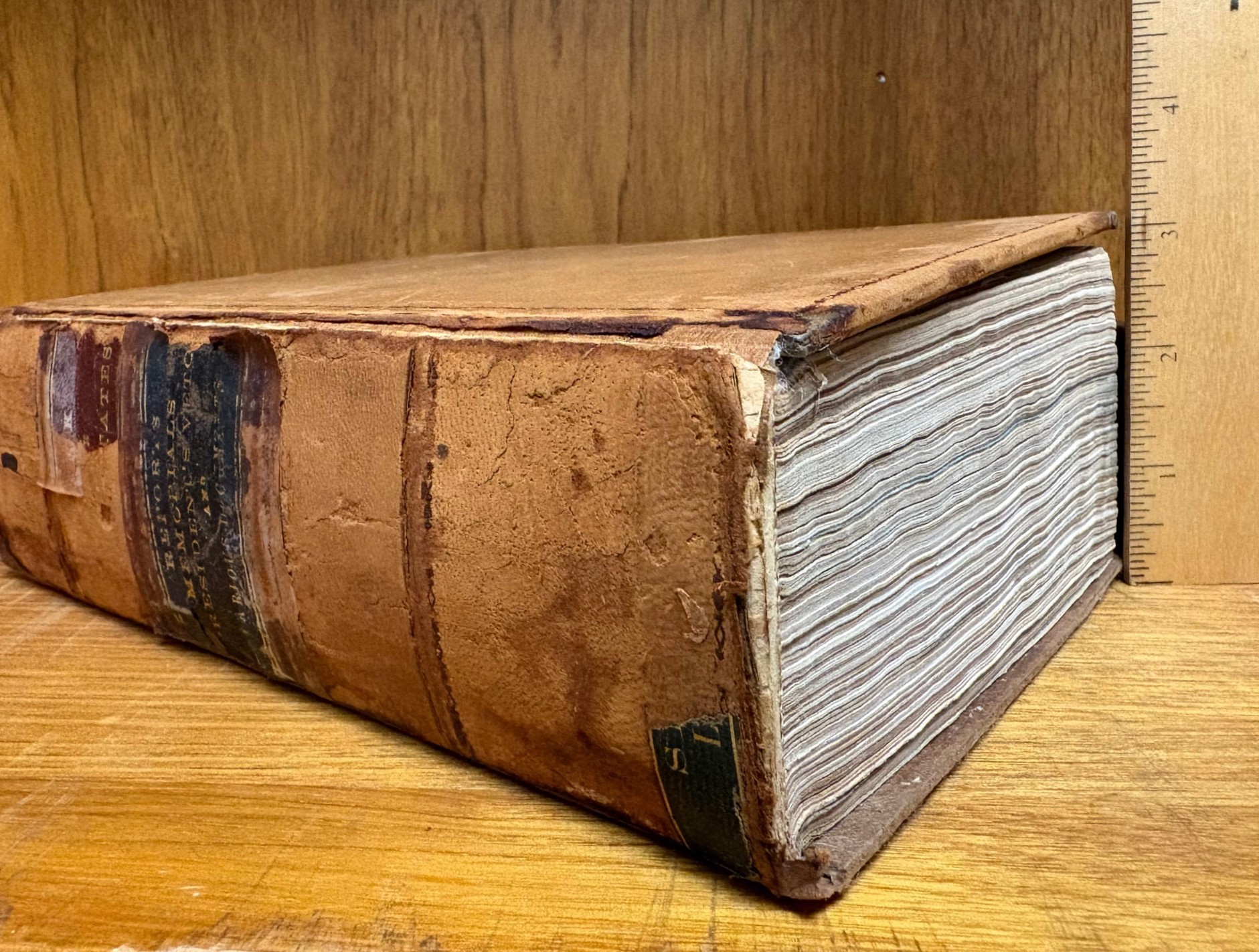
Q: Fragments of the binder's title on this spine indicate that the contents involve "Reports, Memorials, President's Veto and Various Documents." What is the subject matter?
A: Once upon a time, the head of the spine read, "Bank of the United States." After judging this momentous book by its timeworn cover, please open it up and look inside.
Q: Someone has pasted a handwritten title page inside that says, "Memorials and Reports for and against the Bank of the U. States 1832." (image below) The person who assembles a sammelband often coins a collective title. How can one identify this particular compiler?
A. Little did you know that his penmanship compares favorably with a handwriting sample from a letter written by John Silva Meehan (view the manuscript here). As Librarian of Congress from 1829 to 1861, Meehan provided reference material and organized government documents for both houses of Congress.
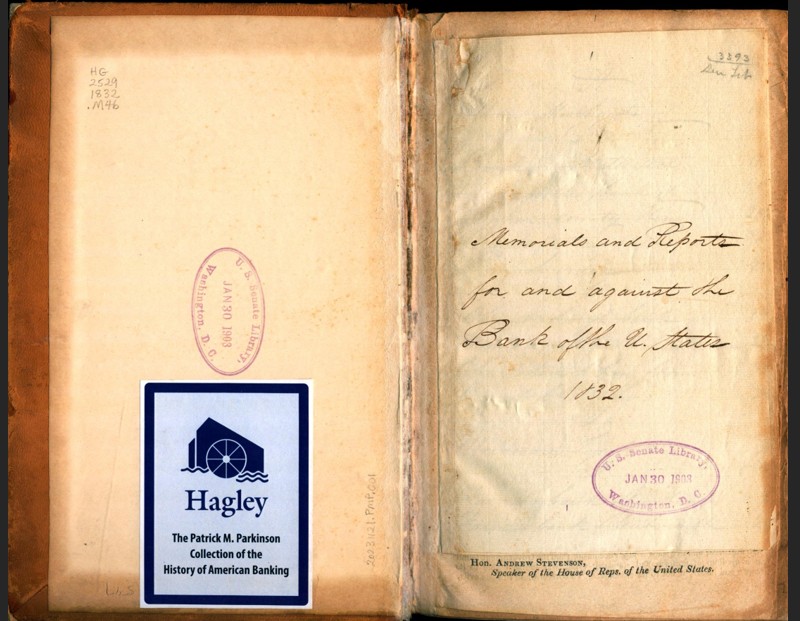
Q. The oval-shaped ownership stamp does proclaim the "U.S. Senate Library," but the date is "Jan. 30, 1903."
A. That date stamp is a red herring. It came well after Meehan's tenure. The Senate Library gained official recognition in 1871 and maintained its independence in the U.S. Capitol Building, even once the Library of Congress moved to the fabulous Jefferson Building in 1897. Five years later, the Senate Library underwent reconstruction to install fireproof steel shelving; perhaps the stamp appeared in the wake of that reorganization. Turn the page.
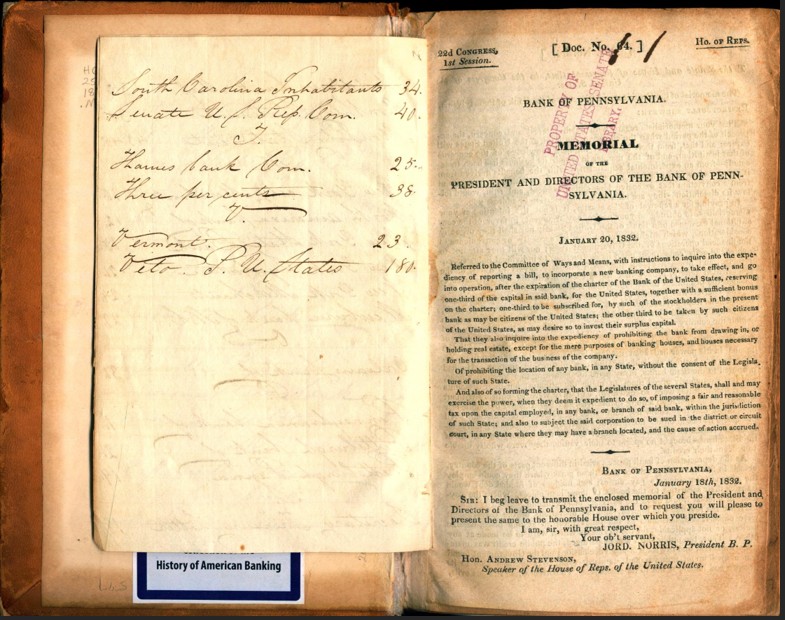
Q. The title is followed by a handwritten index. There are four dozen entries including financial reports and opinion papers. What do all these banks, state legislatures, and private citizens have to say about national banking? (image below)
A: The plot thickens. The U.S. Congress had authorized the Second Bank of the United States (BUS) in 1816 to hold deposits and make payments for the government. It also helped standardize paper currency across the young and sprawling nation. Renewal of the BUS charter drew heated debate toward the end of its 20-year term. Supporters touted economic growth and stability, while opponents favored decentralized power and states' rights. Spoiler alert: President Andrew Jackson ultimately vetoed a bill to extend the BUS charter in July 1832 and won re-election in November by a wide margin.
Q. Noting this background information in our catalog facilitates subject searching for Memorials and reports for and against the Bank of the United States, 1832 online. Each constituent pamphlet in this volume merits a bibliographic record of its own as well, amounting to 48 additional entries in our online catalog. What more can we say?
A. Mr. Parkinson himself characterizes this sammelband as "the U.S. Senate's own documentary history of the events culminating in President Jackson's veto on July 10, 1832 of a bill rechartering the Bank of the United States." You may explore these and other resources of the Parkinson Collection here.
Alice Hanes is the Technical Services Librarian at Hagley Museum and Library