
As I approach the halfway mark of my internship here at Hagley, I reflect on some of the patent models that I have researched, including a coal-oil stove to keep food warm, or a model that was packed with the wrong patent tag. The one I chose to highlight here is a stop and waste-valve – not necessarily for the invention itself but the inventor associated to the patent.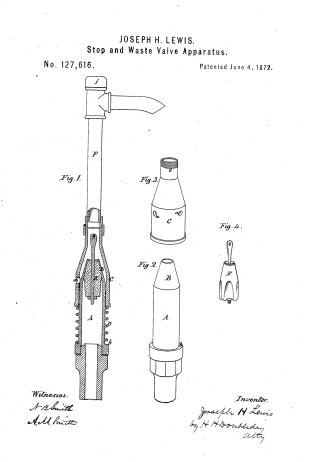
Now before we get into the story of the inventor, what is a stop and waste-valve? A stop and waste valve prevents water from freezing in pipes. A stop valve cuts off the flow of water within pipes. A waste valve gets rid of the water that is left in the pipes after the initial flow of water exits the pipes. And as you can imagine, the stop and waste valve combines both functions into one valve and does it all in one go!
The specific valve in Hagley's collection is Patent #127,616, invented by Joseph H. Lewis in Binghamton New York. The valve combined the stop and waste valve (as described above) and has a specific tube that with inward movement, opens the stop valve and closes the waste valve. With outward movement, the tube does the opposite, closing the stop and opening the waste. The "waste" water would then be dispensed as fresh water from the attached main pipe.
And while researching the inventor, I made an important discovery. The inventor was most likely Black, meaning he is among a small and little researched group of patentees. With an estimated 600,000 patents granted in the 1800's only about 2.7% of them were granted to Black citizens. And of the roughly 5,000 patent models in Hagley's collection, only three are known to be patented by Black inventors.
The first clue was found in the 1892 New York state census where a man with the same name and the residence as listed on the patent application. A 47-year-old Black man named Joseph H. Lewis was living in Binghamton, NY with his wife Lydia, with his occupation as "turner wood." At first, it didn't seem a match and brought about a question: Why would a wood turner want to make improvements to a metal pipe valve?
Continuing my research, I looked at a second census (from 1870) where seemingly the same Joseph H. Lewis (the names of his wife and children closely match those in the 1892 census) was living in another part of New York with a wealthy inventor by the name Leman Baker Pitcher, who owned over a dozen patents. This gave me the idea that Joseph could have been working with Leman when he earned his patent.
With more research into the life of Joseph, I found a listing the 1873 Binghamton directory. The only entry for a "Joseph H. Lewis" was for a wood turner living in town which matched the occupation of the Black man found in the 1892 state census. Further, it asked the reader to "See adv." This ad (see below) was for an "Anti-Freezing Hydrant," manufactured by Joseph H. Lewis & Co.
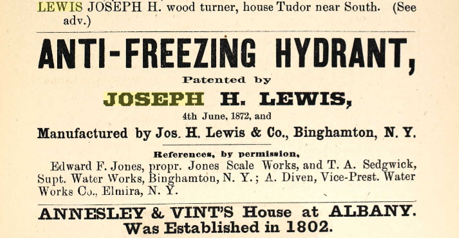
And, as mentioned previously, the patentee of Hagley's model explicitly mentioned how the valve would prevent the pipes from freezing. This provided a solid connection between the patent model and the man living in Binghamton the year after he earned his patent.
His wife Lydia is listed living with him both in the 1870 and 1892 census in addition to another state census in 1875. They also had a son, Joseph Lewis Jr., (1861-1941) whose birthplace is listed as Canada in the 1870 and 1875 census. A later census record for him states that he immigrated to the U.S. from Canada in 1865.
Perhaps the inventor and his wife moved to Canada before the Civil War, which is when/where they had their son. After the war was over, they moved back to the US and resided in New York for the rest of their lives.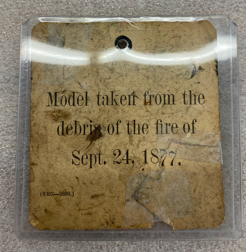
Also attached to the model was a tag (see pic) indicated it was a survivor of the 1877 patent office fire. Meaning, it was one of the objects that was recovered from the flames, making this an even more intriguing find!
It has been so interesting to research things here at Hagley as part of my internship; getting to see all the stories behind the objects while handling the historic object themselves. And as we here at Hagley like to say, it's like opening something new and exciting on Christmas morning!
Cecilia Johnston is the Museum Collections intern at Hagley Museum and Library. She is currently pursuing a bachelor’s degree in business management at Washington College, and her research focuses on patent models and their inventors.