
It's all fun and (video) games at the Hagley Vault today thanks to the contributions of RCA engineer Joe Weisbecker (1932-1990). Weisbecker invented an 8-bit microcomputer architecture that would serve as the foundation of RCA’s future microprocessor business.
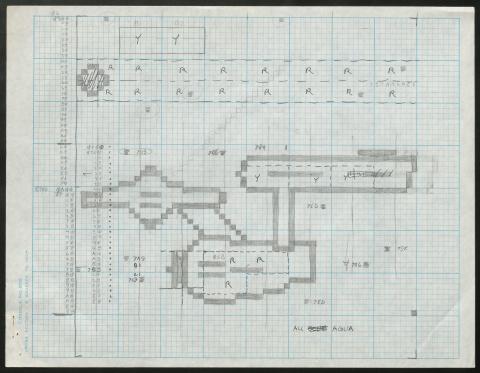
During the 1970s, he contributed to the development of RCA’s programmable video game and educational systems: FRED, STUDIO II, STUDIO III, and STUDIO IV, and Microtutor. This ca. 1972 image shows a page from his computer game planning papers for a Star Trek themed game for the FRED system.
In addition to his work with RCA, Weisbecker ran his own business, Komputer Pastimes, which he used to develop and market simple games, puzzles, and books designed to introduce children and adults to computer language, programming, and technical concepts in a friendly, accessible format. In 1976, one of his daughters, Joyce Weisbecker, became the first female commercial video game designer and the first indie game developer when she was hired to created games for the RCA Studio II.
The Joseph A. Weisbecker papers now reside at Hagley as a subseries of Record Group 11, 'Solid State Research Division records, 1899-2001' in the David Sarnoff Research Center records (Accession 2464.09) collection, which is itself part of the David Sarnoff Library collections (Accession 2464). These collections were the holdings of the David Sarnoff Library, founded in 1967 as part of the David Sarnoff Research Center. When the library closed in 2009, its archival collections were donated to Hagley Library.
You can view a selection of Joe Weisbecker’s section of that collection online now in our Digital Archive. The Joseph A. Weisbecker papers digital collection includes his greeting card prototypes, selected documents related to RCA’s video game systems, and material from Komputer Pastimes. It also includes video clips of gameplay, which were provided by Kevin Bunch working from binaries converted from tapes by Andy Modla and Marcel van Tongeren.