
Our country is commemorating the 250th anniversary of the signing of the Declaration of Independence. While Hagley may not have a copy of the Declaration in its collection, there are other documents bearing the signatures of several of those men who, in signing the Declaration, “mutually pledge[d] to each other our Lives, our Fortunes and our sacred Honor”.
Others were signed by members of that same generation that became known as the Founding Fathers who helped shape our early republic.
Between the passage of the Patent Act of 1790 and its revision in 1836, all U.S. patents were signed by three top federal officials: the Attorney General, the Secretary of State, and the President of the United States.
This requirement was dropped for practical reasons. These men had more important things to do than autograph the nearly 10,000 patents issued during that nearly four-decade span.
Here are a few from our collection along with some information about the invention and the inventors.
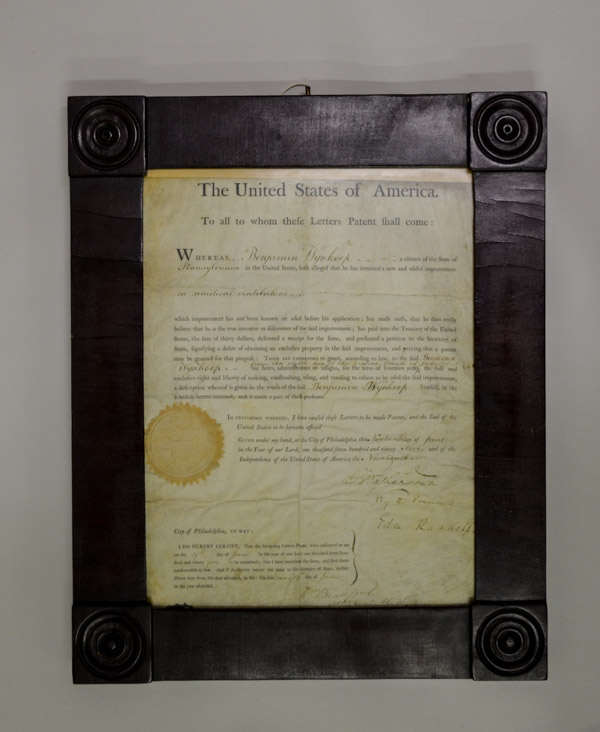
This invention increased the circulation of fresh air around the holds of ships to preserve perishable cargoes and prevent stale air that people, at the time, believed led to the spread of disease in port cities. Born on a plantation in Sussex County, Delaware, the inventor Benjamin Wynkoop later married into a prominent merchant family in Philadelphia and started his own importing business. He brought with him an enslaved person born on his father’s plantation named Absalom Jones. Wynkoop allowed Jones to attend a Quaker school in the city so that he could develop the reading and writing skills to help Wynkoop with his business.
During the British occupation of Philadelphia, Wynkoop left the city to stay with family in Delaware while Jones was entrusted with watching over Wynkoop’s businesses and property. Jones later purchased his freedom, founded the Free African Society, and became the first Black Episcopal priest in America. During the yellow fever epidemic of 1793 that killed about 10% of the city's population, he recruited other Black Philadelphians at Dr. Benjamin Rush's request to care for the sick and dead. Rush wrongfully believed that their African ancestry made them immune to tropical diseases, but they died at about the same rate.
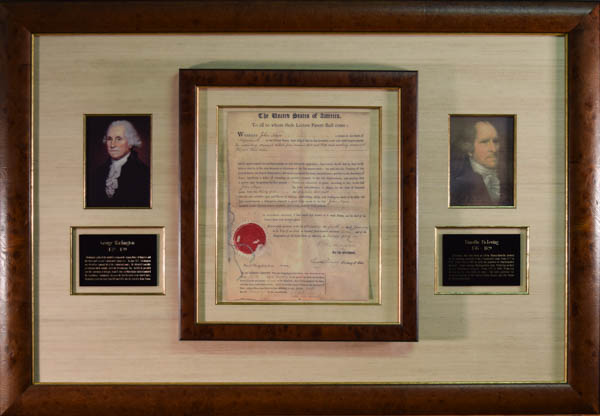
This patent involved the making of pot ash which was used in the manufacture of many products such as fertilizer, textiles, gunpowder, glass, and soap. After further refinement, pot ash became pearl ash which was used as a leavening agent before baking powder was invented in the 1840s. The inventor, John Nazro, was a prominent merchant in Worcester, Massachusetts who actively supported the Patriot cause and owned a store on Queen Street in Boston.
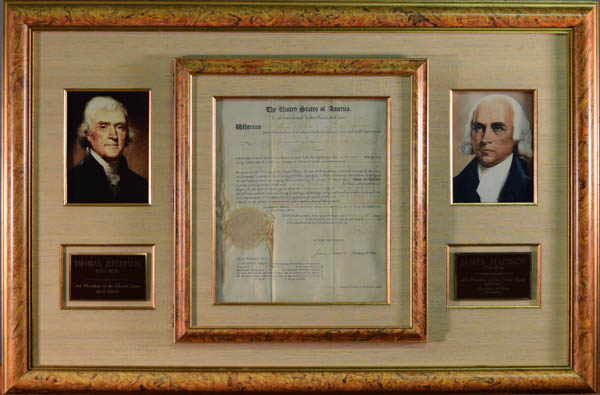
This patent describes in detail the materials and dimensions for the assembly that secured a log to a carriage and guided the log through the sawmill blade as it was cut into straight, uniform planks. These include the supporter, sliding tail block, follower, and setting block, as well as an iron gauge and setter.
Nothing was found on the inventor.
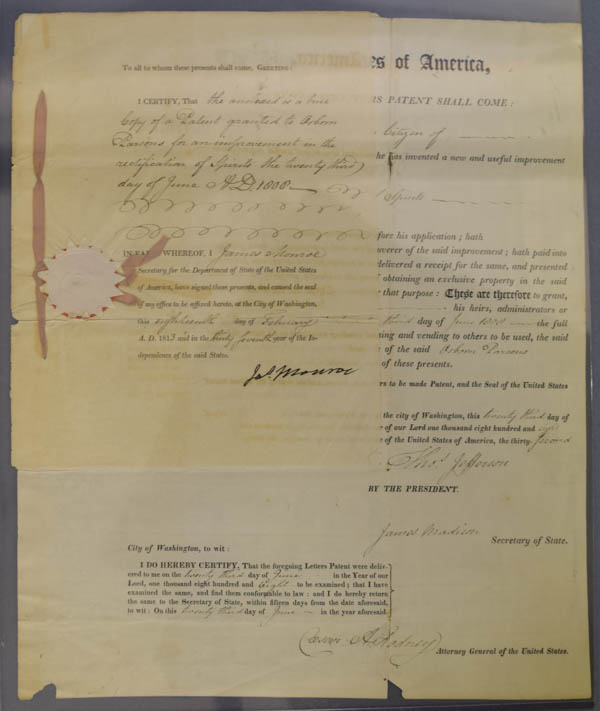
The patent is for a special perforated iron cauldron, or “crater”, used to prepare pulverized charcoal to purify spiritous liquors. Inventor Osborn Parsons claimed that his process was superior to standard filtration methods as it was faster, reduced waste, and produced a “purer and better” spirit. The inventor served in a Connecticut regiment during the Revolution and was present for Lord Cornwallis’s surrender at Yorktown in 1781.
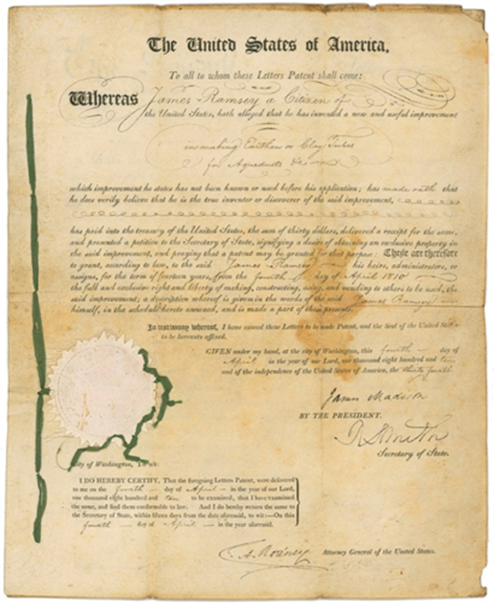
Under this patent, the inventor manufactured clay water pipe and licensed others to do the same. His pipes were installed in towns in Connecticut as well as St. Johnsbury, Vermont and Troy, New York.
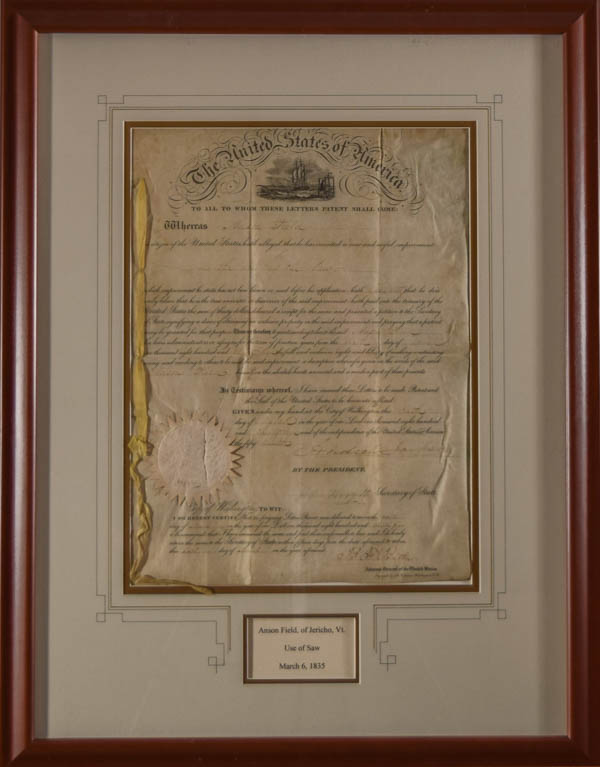
In this patent, the inventor claimed that by bolting or riveting two strips, or “slips”, of iron to the saw blade, “a stick of timber of any size may be taken off by one sweep of saw” and can be “propelled by hand or horse or steam or waterpower”.
Andrew Jackson is most remembered for his military service during the War of 1812 and his presidency. But at age 13, Jackson volunteered as a courier for the Continental Army during the American Revolution. He was captured and harshly treated. A British officer slashed him with his sword after Jackson refused to polish the officer’s boots and he bore the scars for the rest of his life. His brothers also joined the army, and both died during their enlistment. His mother died after contracting cholera while nursing captured American soldiers. These tragic wartime experiences fostered Jackson’s intense hatred for the British. He exacted his revenge on January 15, 1815, when American forces under his command delivered a shocking defeat to the British at the Battle of New Orleans.
Reproductions of the patent documents bearing George Washington’s signature are on view in Nation of Inventors, Hagley’s permanent exhibit celebrating American invention and innovation featuring over one hundred patent models.
Chris Cascio is the Alan W. Rothschild Assistant Curator, Patent Models at Hagley Museum and Library.