
It's a bird…It's a plane…No! It's Snuff-Man!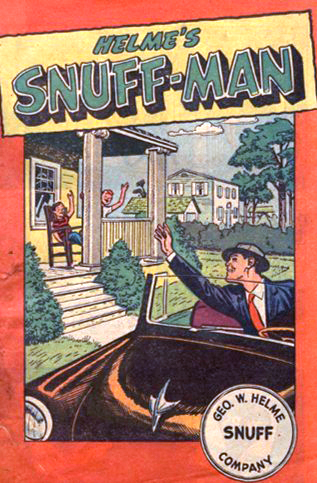
What? You've never heard of Snuff-Man, the greatest comic book hero of all time? That simply can't be! How could anyone ever forget that obscure 1954 comic book about a heroic snuff salesman valiantly teaching two young boys about the plucky origins of tobacco powder.
You're sure you haven't heard of him? Well then, let's discuss Snuff-Man!
Helme's Snuff-Man is a 16-page promotional comic book produced for the George W. Helme Snuff Company of Helmetta, New Jersey. The story revolves around George, the titular Snuff-Man, as he brings a package of snuff (complete with a bow) to a customer's house, meeting her younger brother, Leroy, and his friend. Taking the two young boys aside, the salesman sells them on the wonders the sticky substance.
The aforenoted snuff is a finely ground powder, sniffed up the nose for a direct hit of nicotine. During the 1950s, snuff became more popular as "dip" or chewing tobacco. It was so accepted, in fact, that members of Congress demanded that snuff boxes be placed in the House of Representatives. Fights over a central snuff box, placed at the Vice President's desk, encouraged Congress to adopt two separate snuff boxes on each end of the chamber so that the parties would further distance themselves from one another.
Famed author Charles Dickens, during his visit to the United States in the 1840s, took a far less positive approach to the practice, writing, "Though I were to drop my purse on the floor of the United States Senate, I would not attempt to retrieve it without a gloved hand."
Vic Herman Studios created the Snuff-Man comic book. Herman (1919-1999) was prolific in the promotional comic scene, and he had turned out comics for companies like Western Electric, Philip Morris, Johnson & Johnson, and 7-Up. He started his career in the 1930s as an artist for Hollywood productions, including creating the background characters on the poster for Casablanca (1942). Still, it would be through his experiences during World War II that Herman really gained his fame.
Herman is most well-known to comic book historians today for his creation of Winnie the Wac, a comic character he designed to represent the women serving in the Women's Army Corps in World War II. Winnie was so popular at the time that the United States Army sponsored a Winnie look-alike contest with both the winner WAC PFC Althea Semanchik and Herman, sent on a tour to boost enlistment. A collected edition of the cartoon, along with an introduction by movie star Carole Landis (who was rumored to star in an adaptation), sold more than 85,000 copies.
But what about the company that sponsored the Snuff-Man comic?
Although he was born in Kingston, Pennsylvania, to an old Rhode Island family, George Washington Helme (1822-1893) joined the Confederate Army on March 8, 1862 to serve as a captain in the Crescent City Guards, a New Orleans regiment. Notably, his service in the American Civil War included taking part in the Battle of Shiloh. Following a 90-day enlistment, Helme resigned and was transferred to the mining service of the Trans-Mississippi Department.
Owing to his 1858 marriage to Margaret Appleby, daughter of Leonard Appleby, who owned a snuff mill near Spotswood, New Jersey, Helme took on the company's operation with his brother-in-law Jacob Charles Appleby. By 1878, Helme had become the sole owner, renaming the business the Helme Tobacco Company, and incorporating with a capital stock of $500,000 in 5,000 shares. During the 1880s, Helme purchased land between Spotswood and Jamesburg, New Jersey, which became his mill and his workers' homes. By the time of his death, the town, now named Helmetta, had a population of 500 people with five factories employing over 300 of them.
After Helme's death in 1893, the American Snuff Company—a monopoly owned by James B. Duke of W. Duke & Sons—purchased the company in 1900. Gobbling up companies such as Bruton & Condon (Nashville, Tennessee), Bowers Snuff Company (Changewater, New Jersey), W.E. Garrett & Sons (Philadelphia, Pennsylvania) and more, the American Snuff Company controlled 96% of the entire production of snuff by 1906. Following a 1911 Supreme Court decision in a case brought by President Theodore Roosevelt's administration, the government vivisected the company, recreating the American Snuff Company, the United States Tobacco Company, and, finally, the George W. Helme Company.
Northwest of Hagley, in Yorklyn, Delaware, is one of the Helme company sites, where the Garrett Snuff Mill slowly deteriorates. First settled in the early 1730s by John Garrett I, the site developed over the next two centuries into a profitable snuff business. Their "Garrett Scotch Snuff" even received the seventh trademark in the United States in 1870. Like he did with Helme, James B. Duke acquired the company in 1900 to add to the American Snuff Company. As a result of the American Snuff Company's dissolution, the Garrett Snuff Mill in Yorklyn was given to the George W. Helme Company. By the 1950s, the mill could no longer compete due to outdated machinery. It was only producing about two million pounds of snuff per year after 1945, which amounted to just 5% of the country's total. On October 1, 1954, the same year as Helme's Snuff-Man, the mill stopped operations, laid off 77 men, scrapped the machinery, and sold all the structures.
Helme's Snuff-Man remains one of the rarer promotional comic books, with collectors valuing its odd name and unique premise. After all, it is a comic book promoting tobacco use to children. A copy remains in the Hagley Museum and Library collection, view the entire issue here.
Paulie Wenger is a University of Delaware Graduate Assistant at Hagley Museum and Library