
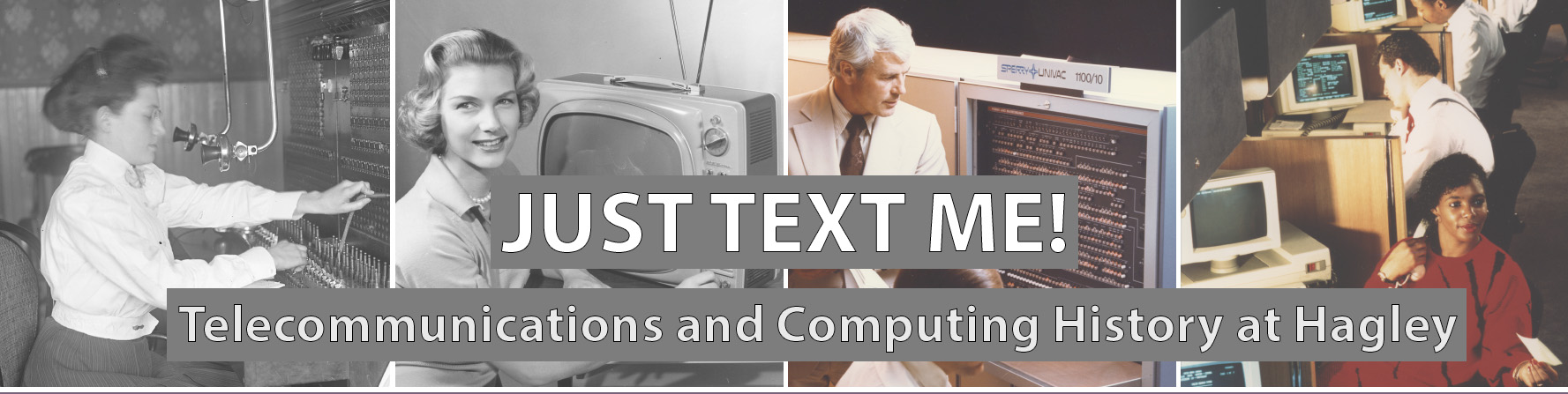
A selection of items from Hagley's extensive collection of unique archives about the history of the telegraph and radio.
E.I. du Pont de Nemours & Co. telegraphic cipher code book, 1888

As telegraph communication networks expanded, some companies developed their own unique codes. Such codes served to lower costs and to increase efficiency and security. View the entire Cipher guide in the Hagley Digital Archives.
Book is from Hagley's Published Collections (HE7677.C4 D9 1888)
Coded telegram to the E.I. du Pont de Nemours & Co., 1888
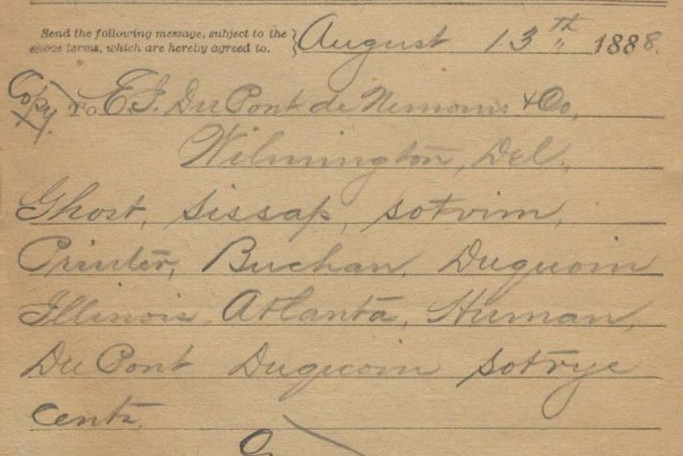
A 1888 Western Union telegram to DuPont using the telegram cipher found in the code book above. See more telegrams to DuPont from 1888 and 1890.
Telegrams from the E.I. du Pont de Nemours & Company nineteenth century records (Accession 0500.I)
Telegram from Roy Wilkins, NAACP, to DuPont, 1968

Telegrams were often used to send important and time-sensitive messages, like this one from NAACP Executive Director asking DuPont to participate in a moment of silence for Dr. Martin Luther, days after his assassination in Memphis. View this item in the Hagley Digital Archives.
Telegram from the Charles Brelsford McCoy papers, Accession 1815)
Marconigram form, circa 1919
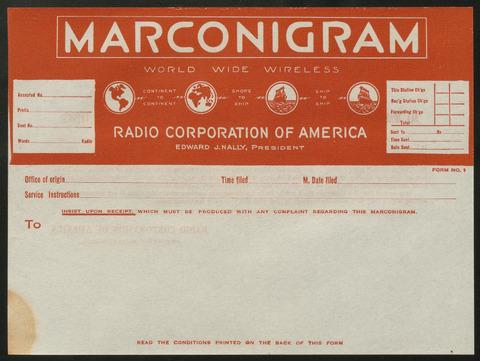
By the late nineteenth century, Americans were sending hundreds of millions of telegrams each year. So, when radio became available as a new communication method, it made sense to call radio messages "wireless telegrams." In 1899, radio inventor Guglielmo Marconi founded Marconi Wireless Telegraph Company of America. General Electric purchased the company's assets in 1919, laying the groundwork for the establishment of its new subsidiary, the Radio Corporation of America.(RCA). See more of the Marconigram form in the Hagley Digital Archives.
Marconigram from the Records of other RCA divisions (Accession 2464.80)
Albert Einstein visits RCA transatlantic radio station, 1921

Radio technology attracted the attention of the greatest scientific minds of the era. In 1921, David Sarnoff of RCA welcomed Albert Einstein, Dr. Charles Steinmetz, Dr. Irving Langmuir, and other scientists at RCA’s newly built transoceanic radio station. View the image in the Hagley Digital Archives.
Photograph from the David Sarnoff Papers Accession 2464.55
RCA radio advertisements, 1925 and 1943

See more advertisements from the John Okolowicz collection of publications and advertising on radio and consumer electronics (Accession 2014.277)