Image
78e7e403829f2d7e52e4b973d1723f6fea512e94.jpg

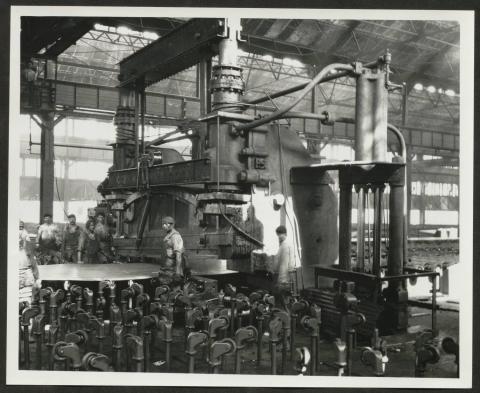
Today's #WorkerWednesday post brings us inside the tool room of the Hoopes Brothers & Darlington sawmill in Brooksville, Florida. A note on the reverse of this ca. 1907 photograph identifies the person on the far right asFrank Orville Reagan(1869-1937), the son of Owen Wily Reagan(1847-1909), the sawmill's manager.

The company that owned the mill, Hoopes Brothers & Darlington, began in West Chester, Pennsylvania in 1867 as a manufacturer of wooden spokes for wheels. By the 1880s it had become one of the largest wooden wheel makers in the United States, with mills and timber harvesting operations established throughout the southern United States.

The mill seen here was established in 1906. Hoopes Brothers & Darlington had originally established their Florida operations in nearby Ocala in 1899, but relocated after exhausting local timber supplies and to take advantage of cheaper railroad freight rates. Owen Wiley Reagan had also managed the Ocala mill, with his son Frank working as assistant manager. After his father's death in November 1909, Frank took over operations of the Brooksville mill.

Image
0c451f4c32113340b4768206fad436e425112768.jpg

Today is Read Across America Day, an event promoted by the National Educational Association since 1998 as a way to promote and encourage children's reading. Which is as good a reason as any to share this illustrated cover from the 1917 Maxwell Book for Kiddies, a small collection of nursery rhymes compiled by Detroit, Michigan's Maxwell Motor Company.

This booklet is part of Hagley Library's Z. Taylor Vinson collection of transportation ephemera (Accession 20100108.ZTV). For over sixty years, Zachary Taylor Vinson (1933-2009), a senior lawyer with the National Highway Traffic Safety Administration, 1993-1995 president of the Society of Automotive Historians, and 1995-2009 editor of Automotive History Review amassed a large and comprehensive collection of printed material documenting on the history transportation, particularly automobiles.

Image
0254ab83ba1e1a43af3980ad152820bb63a9db28.jpg

Today's train wreck of a post features photographs taken on this date, March 1st, in 1906, showing the aftermath of a railroad accident at Emporium, Pennsylvania. The accident, which occurred on the same day, occurred when a Pennsylvania Railroad locomotive tender backed into a box car carrying dynamite manufactured by the Emporium Powder Manufacturing Company. The March 3rd edition of the Philadelphia Inquirer noted that "there was no explosion for some unaccountable reason, and Emporium is still on the map".

These photographs are part of Hagley Library's DuPont Company Museum collection (Accession 1968.001). The materials in this collection were originally compiled by the DuPont Company Museum and document the history of the DuPont Company.

Image
78b781a0932814c6217a8c6ca7623c7967ad8ec5.jpg

On this date, February 26, in 1919, President Woodrow Wilson signed an act of Congress establishing the Grand Canyon National Park as the 15th park in the U.S. national parks system.

As a 102nd birthday present, we're offering this 1917 photograph of a mule ride on the Bright Angel Trail, a six mile trail still traveled by mules and humans alike. The riders in this photograph included the party of P.S. du Pont and Alice Belin du Pont, who traveled to the Grand Canyon that year in the company of Nathaniel Gould Robertson, May B. Robertson, Charles A. Belin, John P. Nields, Mary Blanchard (Craven) Nields, Louisa d'Andelot (du Pont) Copeland, and Charles Copeland.

This photograph is part of Hagley Library's P.S. du Pont Longwood photograph collection (Accession 1969.002). To view more photographs from this collection in our Digital Archive, click here.

Image
e64b52860f6b0e0aeb60a95744aac9ae4dab938c.jpg

The National Society of Professional Engineers has been sponsoring Engineers Weekevery February since 1951 as a means of calling attention to engineers' contributions to society and advocating for the importance of education in math, science, and technical skills.

Today's Engineers Week theme is Introduce a Girl to Engineering Day, so we're sharing this December 1949 photograph of Florence Naum (1922-2006) testing a generator regular quality control machine at the Ford Motor Company's plant in Ypsilanti, Michigan. The device tested regulators for 1950 Fords under simulated road conditions.

Naum was a resident of Farmington, Michigan. She began her career at Ford as a stock handler in 1939 after graduating high school and, by 1949, was the only woman electrical technician at the company and one of only two women enrolled at the University of Detroit in pursuit of an engineering degree. She eventually earned an electrical engineering degree from the University of Michigan and later became the first female electrical engineer employed at the company.

Image
7ea3c05aec09f894e676713e8508b8e4e5ab27ef.jpg

We're excited to announce that tonight, February 24, Hagley, in partnership with Clark Atlanta University andBloomfield College, will be premiering Dr. Wesley Memeger, Jr., Science Into Art, a special documentary chronicling the lifeof Dr. Wesley Memeger, Jr.

Memeger was a long-time DuPont chemist at the Pioneering Research Laboratory. He began working for DuPont's Pioneering Research Laboratory in 1964 and continued his career there until his retirement in 1997. His research enabled the company to streamline the production of Kevlar, a synthetic fiberdeveloped at DuPont by Stephanie Kwolek in 1965, by discovering a faster polymerization process to help scale for industrial production. Memeger and his wife, a fiber artist, are also accomplished artists, with Memeger's work taking inspiration from the geometric shapes found in molecular compounds.

Image
3c8ceab44f1f601f94aec90be6d9748d8e4cb3f8.jpg

Today's #TradeCardTuesday is quite the sticky situation. This advertising card was produced by the Tenexine Company of Boston, Massachusetts to promote its line of Egyptian Te-nex-ine glue. The item is undated, but was probably created between 1880 and 1913.

This card is part of Hagley Library's Fingerman ephemera collection (Accession 2009.213), a collection of mixed-format ephemeraassembled by collectors Arlene and Gerald Fingerman. Advertising cards and labels compose a large portion of this collection, but it also includes billheads, blotters, bookmarks, business cards, catalogs, checks, envelopes, flyers, letterheads, newsletters, packaging, postcards, and stamps.

The collection has not been digitized in its entirety, but you can view a curated selection of materials from it online now in our Digital Archive. Just click here!

Subscribe to